
Signs You Need Dryer Vent Cleaning in Columbus, OH — Before the Fire Risk Builds
Your clothes taking longer to dry is a late-stage warning, not an early one. The real signs you need dryer vent cleaning show up sooner: clothes that finish hot but still damp, an exterior vent flap that barely opens during a cycle, a laundry room that feels noticeably warmer and more humid, and a faint burning smell in the first minutes of drying. In Columbus, where half the homes Paul Torres services have dryer vents routed through interior walls with multiple elbows — especially the 1990s–2000s tract construction in Hilliard, Dublin, Pickerington, and Grove City — these symptoms appear faster and more severely than in homes with short, straight exterior-wall runs. If you’re noticing any of these, your vent is already restricting airflow and accumulating lint at the bends. Call (844) 945-2561 for a free assessment.
Why Columbus Homes Hide Dryer Vent Problems Longer Than They Should
There’s a specific reason the generic “signs you need dryer vent cleaning” lists feel half-right for Columbus. Most of those lists assume a dryer vent punches straight through an exterior wall behind the appliance — a 4-foot run, one elbow, done. That configuration exists here, but it’s not the dominant one.
Walk through a 1998-built home in Hilliard or a 2004 Dublin subdivision and you’ll often find the laundry room positioned centrally, with the dryer vent routed through an interior wall, up through a floor joist bay, or across a basement ceiling before exiting the far side of the house. Two elbows are common. Three aren’t rare. Every bend is a lint trap. Every foot of horizontal run is a place where moisture condenses and lint cakes onto the duct wall.
Paul Torres sees this on nearly every dryer vent cleaning call in Columbus’s outer suburbs. The homeowner says, “It started taking two cycles about a month ago,” but when he runs the inspection camera, he finds a vent that’s been narrowing for a year or more. The lint doesn’t accumulate evenly — it packs at the elbows first, then builds backward like a clogged artery. By the time the dryer can’t push enough air to dry a load in one cycle, the vent is often 60–70% obstructed.
This is the critical gap in most warning-sign lists: they describe end-stage failure. Columbus homeowners with these interior-wall, multi-elbow configurations need to recognize the earlier signals, because their vent geometry accelerates every problem the generic advice warns about.
The Early-Stage Signs Most Columbus Homeowners Miss
Before your dryer demands a second cycle, these subtler symptoms appear. We’ve organized them by what you’re most likely to notice first.
Clothes Finish Hot but Still Damp
This is the earliest reliable indicator. Your dryer’s heating element is working fine — it’s producing plenty of heat — but the restricted vent can’t exhaust the moisture-laden air fast enough. The result: clothes feel hot to the touch at cycle’s end but aren’t fully dry. Many homeowners blame the dryer itself, run a warranty check, or replace a perfectly functional heating element. In our experience across Columbus, this symptom correlates strongly with vents that have at least one 90-degree elbow partially obstructed with lint.
The Exterior Vent Flap Barely Opens
On a properly functioning dryer vent, the exterior flap should lift fully and stay open during the drying cycle. If it only cracks open, flutters weakly, or doesn’t open at all, your dryer’s blower is fighting backpressure. In winter, you might notice this more because the cold Columbus air creates additional density resistance — a vent that’s marginal in October fails completely by January.
Check yours during the next load. Stand outside while the dryer runs. If the flap isn’t lifting decisively, you have a restriction.
The Laundry Room Warms Up and Feels Humid
A dryer vent’s job is to move hot, moist air outside. When it can’t, that air backs into the room. You’ll feel it as elevated temperature and humidity — sometimes enough to fog a window or make the space feel “sticky” during a cycle. In Columbus’s already-humid summer months, when July dew points climb into the upper 60s, this effect compounds. The laundry room becomes noticeably uncomfortable, and the excess humidity can promote mold growth on nearby walls or in adjacent spaces.
Burning Smell in the First Few Minutes
This one gets our immediate attention when a homeowner reports it. A faint burning or “hot dust” odor during the initial minutes of a cycle means lint — which is highly flammable — is contacting hot surfaces or smoldering in a restricted section of duct. The smell often fades as the cycle continues, which leads some homeowners to dismiss it. Don’t. This is your vent communicating directly that a fire risk exists.
The National Fire Protection Association reports that dryer vent fires peak in January, when heavy winter clothing increases lint production and cold exterior temperatures reduce exhaust airflow. Columbus’s hard winters and the city’s prevalence of multi-elbow vent runs create a local risk profile higher than the national baseline.
The Columbus Housing Stock Hazard: Accordion Flex Vent
There’s a specific material issue in Columbus’s older housing that most warning-sign lists never mention. Homes built in the 1980s and 1990s — including many in the Hilltop, Linden, and South Side neighborhoods, plus early suburban developments — were often fitted with flexible plastic or foil accordion-style dryer vent hose. This material is no longer code-compliant, and for good reason.
The accordion ridges trap lint in their folds. The flexible construction sags between supports, creating low points where moisture collects and lint cakes into dense, almost mortar-like blockages. The thin foil or plastic can be crushed by incidental contact, pinching the airway to a fraction of its intended diameter.
Paul Torres finds this material still in place on roughly one in five Columbus dryer vent cleaning visits. Homeowners often don’t know it’s there — it’s hidden in a wall or ceiling cavity. During a professional cleaning, we identify it, document it with camera footage, and explain why replacement with rigid metal duct is necessary for both safety and performance.
If I wouldn’t put it in my own house, I won’t recommend it for yours.
The “I Clean the Lint Trap” Assumption — and Why It’s Not Enough
This is the most common misconception we encounter. The lint trap catches approximately 25–35% of the lint produced per drying cycle. The remaining 65–75% enters the vent ductwork. Over a year of normal use for a family of four — roughly 300–400 loads — that’s a substantial volume of fine, combustible material accumulating in a confined space.
Cleaning the lint trap is essential maintenance, but it’s entirely separate from vent duct maintenance. Think of it like changing your car’s oil filter: necessary, but not a substitute for draining the oil. The trap protects the dryer’s internal components; the vent duct protects your home.
In Columbus’s hard-water areas, which include much of the municipal supply, lint also binds with mineral deposits from evaporated moisture, creating harder, more adherent buildup than in soft-water regions. This accelerates restriction in vents that already struggle with geometric challenges from multi-elbow routing.
Common Local Scenarios: What Paul Sees in Columbus Neighborhoods
These aren’t hypotheticals. These are recurring conditions from eight years of running Rotobrush and Nikro equipment through Columbus homes.
- Hilliard and Dublin, 1995–2005 builds: Laundry rooms positioned for floor-plan efficiency, not vent geometry. Vents run 15–25 feet with two or three elbows, often through unconditioned attic spaces where summer heat bakes lint onto duct walls. We regularly extract 3–5 pounds of compacted lint from these runs.
- Grove City and Pickerington, 2000s subdivisions: Similar routing issues, compounded by newer homeowners who assume “newer construction” means “no maintenance needed.” These vents often reach critical restriction at 3–4 years without cleaning — faster than the 5–7 year interval often cited for older homes with straighter runs.
- Hilltop and Linden, 1940s–1960s ranches with forced-air conversions: The dryer vent situation here is often better — shorter exterior-wall runs are common — but we find accordion flex material still in place from decades-old installations, or DIY repairs with duct tape that has degraded and leaked lint into wall cavities.
- Near East Side and Whitehall, mid-century homes: Paul grew up a few blocks from Franklin Park on the Near East Side, and he knows these neighborhoods’ housing stock intimately. Dryer vents here are often retrofitted into spaces never designed for them, with creative but problematic routing through crawl spaces or attached to aging masonry with inadequate support.
What Professional Dryer Vent Cleaning Actually Involves
When you call Legacy Air Duct Cleaning Columbus for Dryer Vent Cleaning, you’re getting a complete service, not a quick brush-through with a shop vacuum.
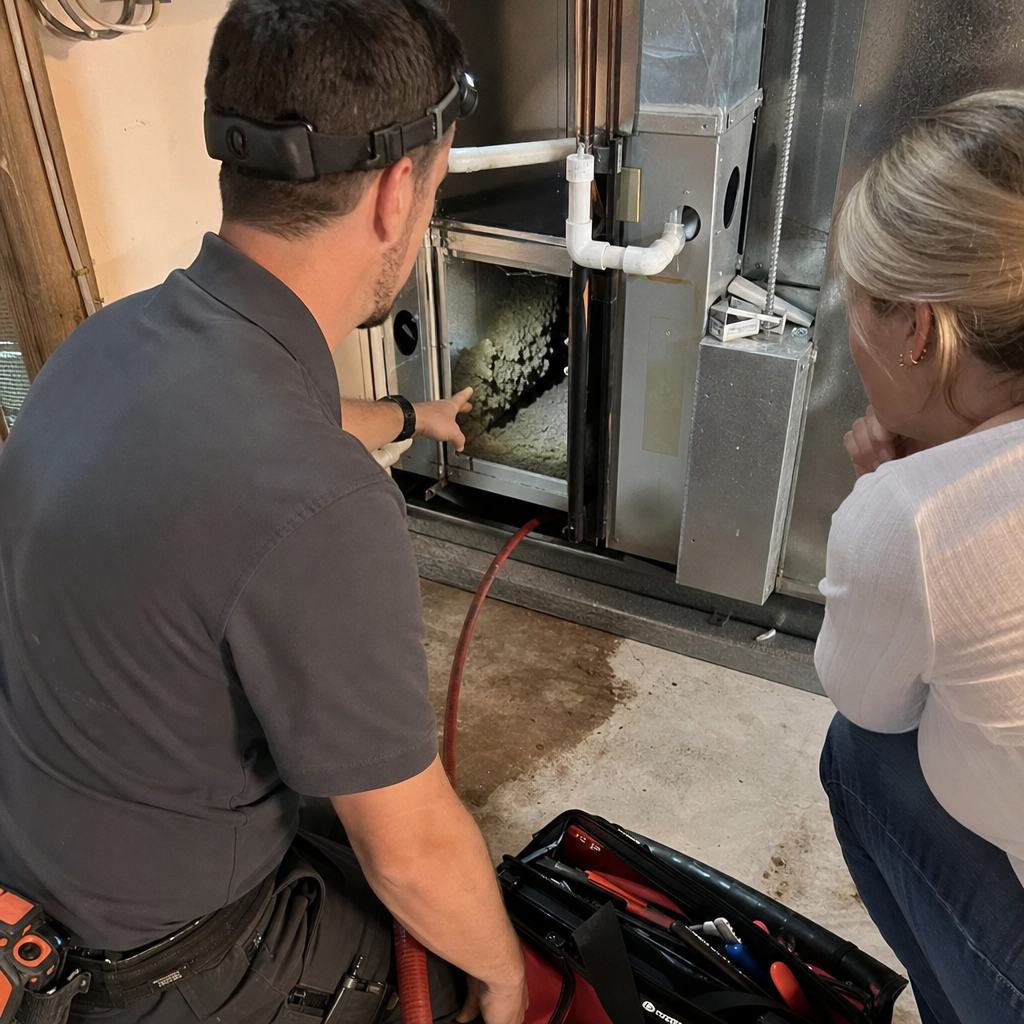
Paul Torres arrives as lead technician — the same person who owns the company, completed his HVAC coursework at Columbus State Community College, and has spent eight years specializing in duct systems. He inspects the full vent run with a camera where accessible, identifies material and routing issues, and cleans using professional-grade equipment.
Our process:
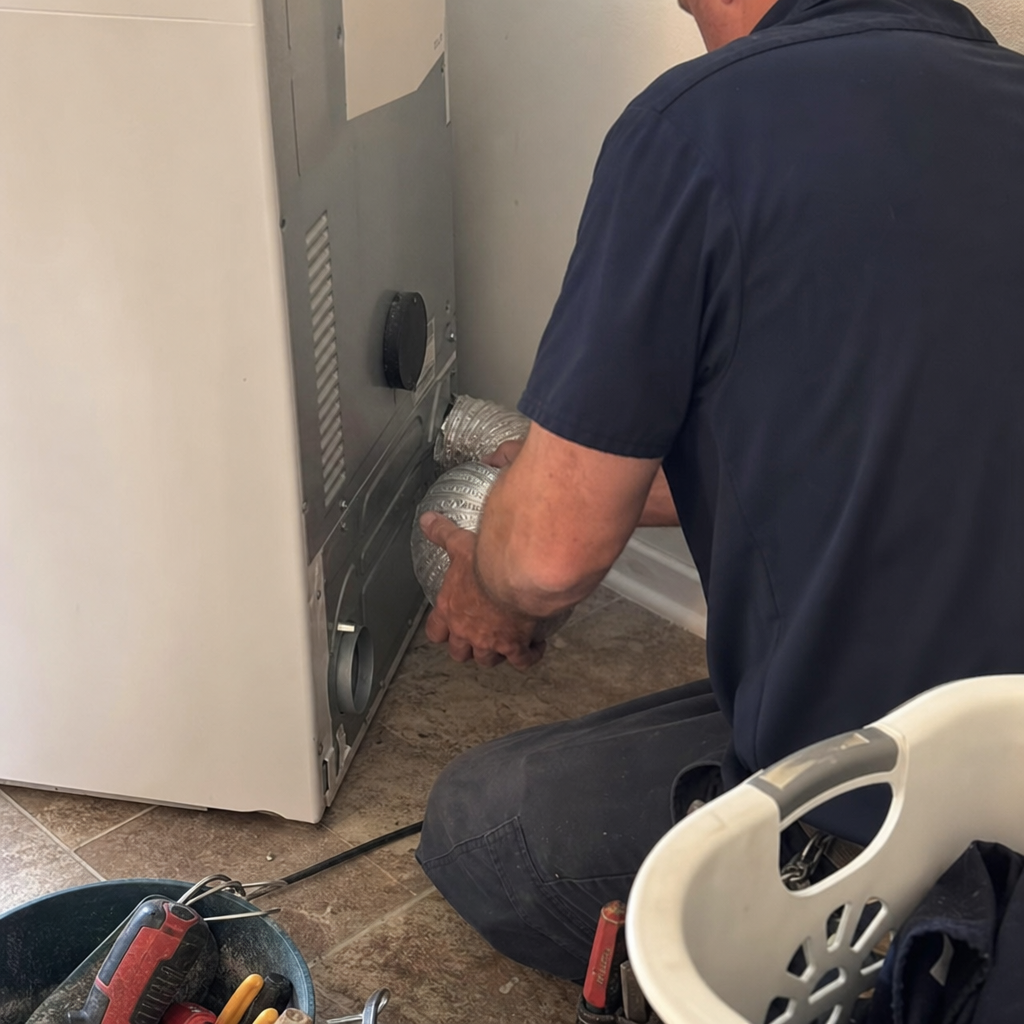
- Disconnect and inspect the dryer connection point for lint accumulation and material condition
- Run mechanical agitation tools — Rotobrush and Nikro systems — through the full duct length to dislodge adhered lint
- Apply negative-pressure vacuum extraction to remove dislodged material without dispersing it into your home
- Inspect exterior termination for proper flap operation and screen condition (screens should be removed or replaced with louvered caps — screens trap lint)
- Document findings with before/after camera footage where accessible
- Flag any material or routing issues requiring correction, with straightforward recommendations on priority and timing
The job typically takes 60–90 minutes for a standard residential vent. Longer runs with multiple elbows or significant obstruction may extend to two hours. We don’t flat-rate complex jobs into inadequate time — the vent gets fully cleaned or we don’t consider it done.
When to Call vs. What You Can Check Yourself
There are safe preliminary checks any homeowner can perform:
- Verify the exterior flap opens fully during a cycle
- Confirm the lint trap is clean and properly seated
- Check that the dryer isn’t pushed too tightly against the wall, crushing the connection hose
- Look for visible lint accumulation at the exterior termination
What we don’t recommend: disassembling interior ductwork, attempting to clean long vent runs with consumer-grade tools, or operating a dryer that emits burning odors. The flex-vent material in many Columbus homes is fragile; improper handling can detach it inside a wall cavity, creating a hidden lint accumulation zone that’s worse than the original problem.
For any symptom beyond the basic checks, or if your home matches the Columbus builder-era vent routing described above, professional assessment is the safer path.
FAQs
How Much Does Dryer Vent Cleaning Cost? (2026 Price Guide) — Columbus, OH: typically $120–$180 for a standard residential vent with accessible termination and single-story routing. Longer runs with multiple elbows, interior-wall routing, or significant obstruction requiring extended agitation time may reach $200–$250. We assess the specific configuration before starting work and confirm pricing — no surprises, no pressure to add services. Call (844) 945-2561 for an exact quote on your home; estimates are free.
Consumer-grade dryer vent cleaning kits ($20–$40 at hardware stores) can handle short, straight vents with light lint accumulation, but they’re ineffective on the multi-elbow, interior-wall configurations common in Columbus’s 1990s–2000s housing stock. The flexible rods often bind at elbows, the brushes lack the agitation force of professional Rotobrush or Nikro equipment, and there’s no extraction vacuum — dislodged lint simply resettles. More critically, DIY attempts on aging accordion flex vent can detach or damage the material, creating hidden hazards. For most Columbus homes, Best Dryer Vent Cleaning in Columbus, OH is both more effective and safer. Call (844) 945-2561 to discuss your specific vent configuration.
For Columbus homes with standard exterior-wall dryer vents, every 2–3 years is typical. For the interior-wall, multi-elbow configurations common in Hilliard, Dublin, Pickerington, and Grove City, annual inspection and cleaning every 12–18 months is prudent — the geometric restrictions accelerate lint accumulation. Homes with accordion flex vent material (still found in many 1980s–1990s Columbus builds) should be inspected annually regardless, as the material itself is a degradation hazard. Paul Torres can assess your specific routing and material during a cleaning visit and recommend an appropriate interval. Call (844) 945-2561 to schedule.
We maintain same-day and next-day availability for dryer vent issues showing active warning signs — burning smells, complete airflow failure, or exterior flap non-operation. These symptoms indicate elevated fire risk, and we prioritize them in our scheduling. For standard maintenance without active symptoms, we typically book within 3–5 business days. Call (844) 945-2561 to describe what you’re seeing; we’ll slot you appropriately and give you an honest timeline.
What Happens If You Ignore the Signs
The progression from early symptoms to serious hazard isn’t linear — it accelerates. A vent that’s 30% restricted performs noticeably worse; one that’s 60% restricted is approaching failure. The final stage before complete blockage often involves the dryer’s high-limit thermostat cycling the heating element on and off, which stresses components and can cause overheating.
More seriously, lint is ignitable at temperatures a stressed dryer can produce. The U.S. Fire Administration attributes approximately 2,900 home dryer fires annually to failure to clean dryer vents. Columbus’s specific risk factors — multi-elbow routing, aging accordion flex material, hard-water mineral binding — mean local homes can reach critical restriction faster than national averages suggest.
Early recognition and prompt cleaning eliminate this risk entirely.
Key Takeaways
- Hot-but-damp clothes, weak exterior flap lift, humid laundry rooms, and burning smells are early warnings — not “normal” dryer behavior
- Columbus’s 1990s–2000s builder homes frequently have interior-wall, multi-elbow vent runs that accelerate lint accumulation
- Accordion flex vent material, common in 1980s–1990s Columbus construction, is obsolete, hazardous, and still present in many homes
- Lint trap cleaning prevents about 30% of lint; the remaining 70% enters the vent duct and requires separate maintenance
- Professional cleaning with mechanical agitation and negative-pressure extraction is necessary for complex vent configurations
If you’d rather have it looked at, Legacy Air Duct Cleaning Columbus offers Affordable Dryer Vent Cleaning in Columbus, OH with a no-pressure assessment — call (844) 945-2561.
Written by Paul Torres, Owner & Lead Technician at Legacy Air Duct Cleaning Columbus, serving Columbus, OH.