
How Often Should You Clean Your Air Ducts in Columbus, OH? Most Homes Need It Every 3–5 Years, But Your First Clean and Your Duct Type Change Everything
Most residential air duct systems in Columbus should be professionally cleaned every 3 to 5 years under normal conditions. However, if your home was built between 1990 and 2010 and has never had a post-construction cleaning, that timeline collapses to “as soon as possible” — the flex-duct systems common in Hilliard, Dublin, Pickerington, and Grove City are still circulating drywall dust and insulation fibers from the original build. For a maintained system after that first thorough cleaning, the 3-to-5-year window becomes realistic. Call (844) 945-2561 if you’re unsure which category your Columbus home falls into — we’ll inspect it and tell you straight.
Why the “3 to 5 Years” Rule Falls Apart in Columbus’s Actual Housing Stock
The standard recommendation you’ll find online was written as a national average. It wasn’t written for a city where the dominant housing stock is 1990s–2010s builder-grade tract homes with flex duct run through 140°F attics in July, or for the inner-ring neighborhoods where 1950s ranch homes still run on converted coal-era trunk lines.
Paul Torres, Owner & Lead Technician at Legacy Air Duct Cleaning Columbus, grew up on Columbus’s Near East Side near Franklin Park and has spent eight years crawling through both types of systems. Here’s what actually drives cleaning intervals in this market.
The Flex-Duct Problem in Columbus’s Suburban Rings
Columbus has been one of the fastest-growing large cities in the Midwest since 1990. That growth produced vast rings of subdivisions — Hilliard, Dublin, Pickerington, New Albany, Grove City — where homes went up fast and ducts went in faster. Flexible ductwork, cheap to install and easy to route around trusses, became the default. The problem: it was rarely cleaned after construction, and it’s uniquely vulnerable to Columbus’s climate.
Flex duct in an unconditioned Columbus attic experiences a brutal annual cycle. July dew points in the upper 60s°F mean humid outdoor air meets cold supply ducts every time your AC runs. Condensation forms at joints and register boots. The flexible inner liner, already prone to sagging between supports, traps that moisture along with the construction debris that never got vacuumed out in 2003 or 2007 or 2012.
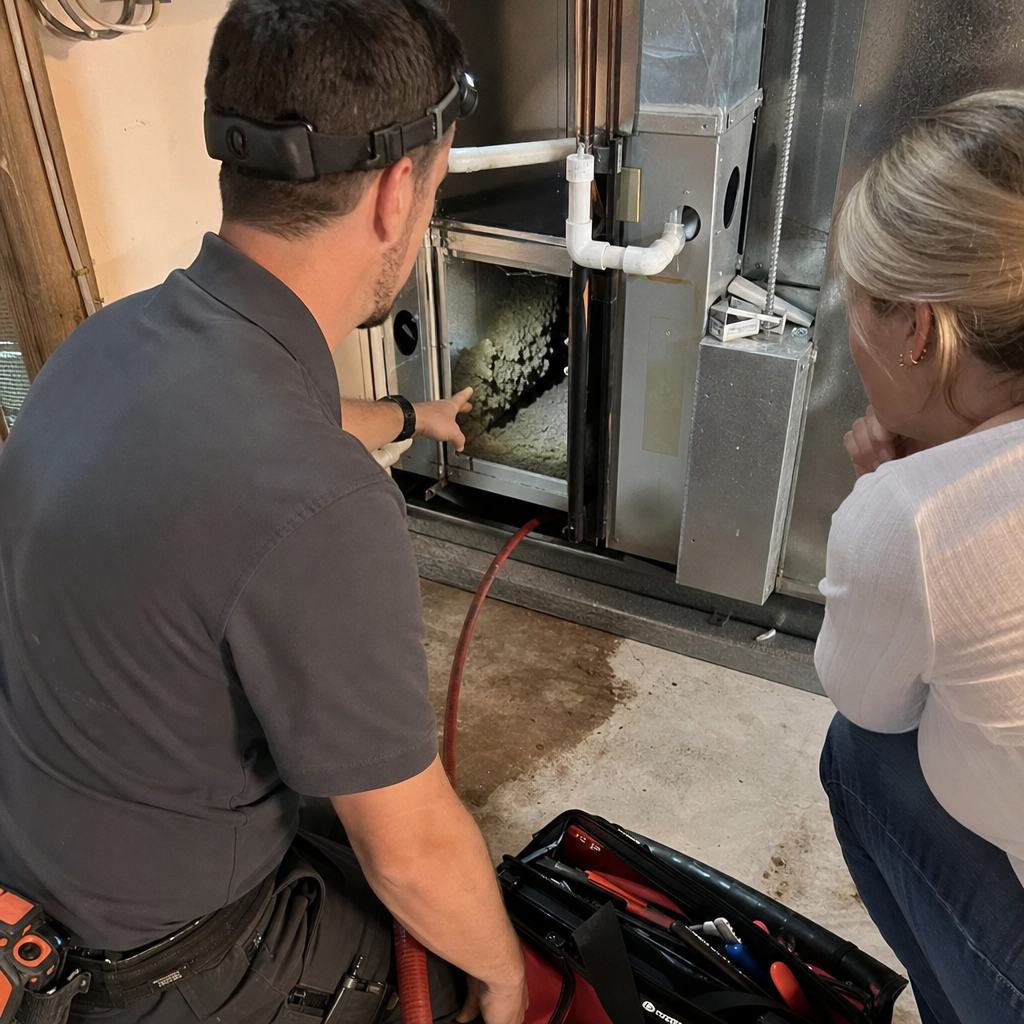
We’ve opened flex-duct systems in Westerville and Reynoldsburg where the first cleaning pulled out not just dust but chunks of drywall compound, wood scraps, and degraded insulation that had been recirculating since the Bush administration. That’s not a 3-to-5-year maintenance scenario. That’s a “this should have happened fifteen years ago” scenario.
The First Clean Resets the Clock Differently Than Maintenance
This distinction matters more than almost anything else, and it’s the detail most competitors gloss over because it doesn’t fit a simple calendar reminder.
A never-cleaned 2005 build in Grove City with flex duct is not on the same timeline as a 2018 build in Powell that was cleaned after construction and has been on a maintenance schedule. The first cleaning on those never-touched systems is remediation, not maintenance. We’re removing construction debris that was baked in before you ever moved in, plus eight to eighteen years of accumulated household particulate.
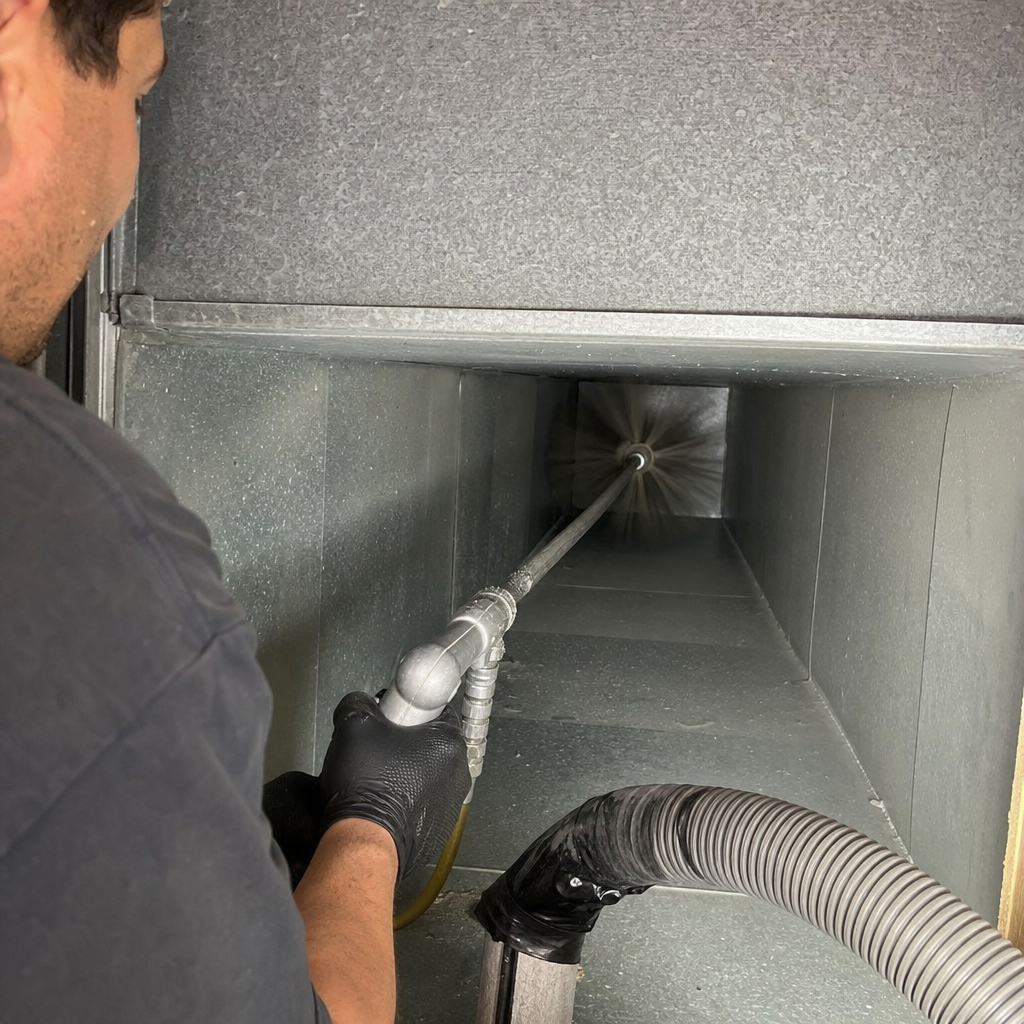
After that first thorough cleaning with our Rotobrush and Nikro mechanical agitation systems, then the 3-to-5-year interval becomes applicable. The system is starting from a true baseline. Until then, the “every 3 to 5 years” advice is actively misleading — you’re treating a contaminated system as if it were maintained.
When the Calendar Doesn’t Matter: Condition-Based Triggers
There are specific events and conditions that should override any timeline, and several are particularly relevant in Columbus homes:
- Visible discoloration or musty supply air after AC season. That late-summer humidity cycle we mentioned? If you’re smelling it, microbial growth is likely established at a cold supply joint against warm attic air. This is especially common in flex-duct systems with poor attic sealing.
- Recent remodeling with drywall work. Fine drywall dust gets pulled directly into return air. We’ve seen systems in Clintonville and German Village where a kitchen reno in March meant the ducts were coated by April.
- HVAC system replacement. New equipment gets connected to old ducts, and the disturbance sends settled debris airborne. The new system’s higher static pressure can also reveal leaks that were previously passive.
- Known water intrusion near duct runs. Columbus’s freeze-thaw cycle and summer storms mean roof leaks and basement seepage are common. Any moisture near ductwork is an immediate inspection trigger.
- Unusually heavy ragweed seasons. Columbus consistently ranks among Ohio’s worst metro areas for ragweed pollen in late August through October. When residents seal up and recirculate air heading into heating season, loaded ducts become an allergen reservoir.
Paul’s approach on these calls is direct: he’ll run a camera, show you what he’s seeing, and tell you whether cleaning is warranted or if you’re fine for another year. “If I wouldn’t put it in my own house, I won’t recommend it for yours.” He’s built nearly 1,000 reviews on that straight talk — 935 verified customers at a 4.7-star rating don’t happen by upselling people who don’t need it.
How Columbus’s Older Housing Stock Changes the Equation
Not every Columbus home fits the flex-duct profile. In Hilltop, Linden, and the South Side, we regularly work 1940s–1960s ranches and bungalows with rigid sheet-metal trunk-and-branch systems — some converted from gravity coal-furnace ductwork with oversized 18-inch-plus trunk lines.
These systems present a different cleaning challenge and a different timeline logic. The massive rectangular ducts can hold decades of compacted particulate, but they’re nearly impossible to fully pressurize with standard residential HEPA-vacuum equipment. The negative-pressure pull that works fine on 6-inch flex duct barely moves air through a 20-by-24-inch coal-era trunk. Extended dwell time and manual agitation with our Nikro equipment add significant job time that flat-rate pricing from franchise outfits rarely accounts for.
For these homes, the interval question is less about “how often” and more about “has anyone ever actually cleaned this properly.” A quick blow-and-go with a shop vacuum — the standard from generalist handymen who list duct cleaning as an add-on — barely touches the compacted layers in these older systems. When we do clean them thoroughly, the interval typically stretches longer than flex duct because rigid metal doesn’t trap debris the same way, and there’s no flexible liner to degrade.
What Our Inspection Actually Covers — And What We Charge
We’re not going to tell you to clean ducts you don’t need cleaned. Here’s how our assessment works:
| Service Element | What’s Included | Typical Range |
|---|---|---|
| Initial camera inspection | Visual assessment of trunk lines, branch ducts, and return plenum; moisture and microbial checks at supply boots | Free with scheduled service |
| Standard residential cleaning (flex duct, 1 HVAC system) | Rotobrush mechanical agitation, negative-pressure HEPA extraction, register and boot cleaning | $350–$550 |
| Rigid metal / converted gravity system | Extended manual agitation with Nikro equipment, specialized trunk-line access, longer dwell time | $450–$750 |
| Post-construction / first-ever clean | Heavy debris remediation, multiple pass cleaning, construction material removal | $450–$700 |
| Air quality sanitizing (add-on) | Application of EPA-registered treatment using Guardsman products | $75–$150 |
These ranges reflect what we actually charge for Affordable Air Duct Cleaning in Columbus, OH, accounting for the housing stock realities we’ve described. A 2,200-square-foot flex-duct home in Powell with one system and normal accumulation falls at the lower end. A 3,400-square-foot Linden ranch with converted coal-era ducts and forty years of compacted debris falls at the upper end, and we’ll tell you that before we start.
Air Duct Cleaning is our entire business, not a side service. We’ve invested in the same Rotobrush and Nikro platforms used by industrial IAQ contractors because homeowner-grade equipment doesn’t handle Columbus’s actual duct conditions.
Household Factors That Shorten Any Timeline
Even with the housing-stock variables accounted for, certain household conditions accelerate accumulation regardless of duct type:
- Multiple pets with shedding coats. Pet dander is lightweight and recirculates aggressively. Homes with two or more dogs or cats typically need cleaning at the shorter end of any interval.
- Indoor smoking. Tar and particulate bond to duct surfaces and attract additional buildup. These systems can need cleaning every 2 years.
- Recent renovation without isolation. We mentioned drywall dust; sanding hardwood floors is equally aggressive on returns.
- Young children or immunocompromised residents. Not because ducts are automatically dirtier, but because the consequence of loaded ducts is higher for these households, making proactive maintenance more justified.
Paul doesn’t recommend annual cleaning as a default for any of these situations unless there’s a specific trigger. An inspection if you’re concerned, yes. A full cleaning every year regardless of condition, no. Most systems don’t need it, and we’ll say so when we get there.
What “Clean Enough” Actually Looks Like
After eight years and nearly 1,000 jobs, we’ve developed a practical standard: if we wouldn’t want our own families breathing what’s coming out of that system, we clean it. If we run the camera and see normal accumulation that hasn’t reached a threshold of concern, we tell you to wait.
The visual markers we use:
- Visible debris at registers or in visible duct sections
- Musty or stale odor when HVAC cycles on
- Excessive dust settling on surfaces within 48 hours of cleaning
- Allergy symptoms that worsen when system runs
- Inconsistent airflow from room to room (can indicate blockage)
None of these require you to know your duct type or construction history. They’re symptoms you can observe, and they’re the reason we offer no-pressure inspections throughout Columbus and the surrounding areas.
FAQs
Professional air duct cleaning in Columbus typically ranges from $350 to $550 for a standard single-system residential job with flex duct, and $450 to $750 for older rigid-metal or converted gravity systems that require extended agitation time — see our guide to Whole House Air Duct Cleaning Cost in Columbus, OH for a full breakdown. The first cleaning on a never-cleaned post-1990 build often runs $450–$700 due to construction debris remediation. Call (844) 945-2561 for an exact quote on your specific system — estimates are free.
Waiting too long usually costs more, not less. A system that goes 10–15 years without cleaning — common in Columbus’s 1990s–2010s builds — often requires heavier remediation, possible duct repair where flex has degraded, and sometimes sanitizer treatment for microbial growth. The incremental cost of cleaning on a reasonable interval is almost always lower than the compounded cost of deferred maintenance. If you’re unsure where your system stands, an inspection will clarify whether you’re in maintenance mode or remediation mode.
Dirty air ducts can exacerbate allergies, asthma, and respiratory irritation, particularly in Columbus’s heavy ragweed season when recirculated pollen loads peak. They can also harbor mold and bacteria in humid conditions, though they rarely cause acute illness in healthy adults. The more relevant concern for most Columbus homeowners is chronic exposure to accumulated particulate — construction debris, pet dander, dust mites, and insulation fibers — that aggravates existing conditions. If someone in your household has worsening respiratory symptoms, an inspection is warranted.
The most reliable indicators are observable: visible dust or debris at registers, musty odor when your HVAC cycles on, excessive household dust that returns quickly after cleaning, or allergy symptoms that correlate with system runtime. In Columbus specifically, flex-duct homes with musty supply air after AC season often have condensation-related microbial growth at cold joints. If you notice any of these, call (844) 945-2561 — we’ll run a camera and show you exactly what’s inside.
When to Call for an Inspection vs. Waiting
We’re not going to invent urgency where none exists. But we will tell you that the “3 to 5 years” rule, applied blindly to Columbus’s housing stock, leaves a lot of families breathing debris that should have been removed years ago.
If your home was built between 1990 and 2010 and you’ve never had a professional cleaning, that’s not a maintenance question — it’s a remediation question. If you’ve noticed musty air, visible register discoloration, or post-renovation dust that won’t quit, that’s a condition question, not a calendar question. And if you’ve got rigid metal ducts in a 1950s ranch and you’re not sure anyone’s ever cleaned them properly, that’s an assessment question.
Paul Torres shows up personally as lead technician on your job. He runs the Rotobrush and Nikro equipment himself, talks to you after the inspection, and tells you whether cleaning is warranted or if you’re fine to wait. That’s how we’ve earned 935 verified reviews at 4.7 stars — by being straight with people about what actually needs doing.
If you’d rather have it looked at, Legacy Air Duct Cleaning Columbus offers a no-pressure assessment in Columbus — call (844) 945-2561.
Written by Paul Torres, Owner & Lead Technician at Legacy Air Duct Cleaning Columbus, serving Columbus, OH.