
Last updated July 10, 2026
Seasonal Air Duct Cleaning Care for Columbus: Year-Round Homeowner’s Guide
Central Ohio’s swing from 90% summer humidity to dry forced-air winters creates a cycle that accelerates debris buildup and mold risk faster than the national average suggests. Most Columbus homeowners hear the same generic advice—”clean your ducts every 3 to 5 years”—but that timeline ignores how our four-season climate actually stresses your system. In this guide, we’ll map what’s happening inside your ductwork during each season, when intervention matters, and how to build a maintenance schedule that matches your home’s real conditions. Whether you’re in German Village, Clintonville, or out toward New Albany, the seasonal pattern is the same—and so is the opportunity to protect your indoor air quality.
Quick Answer
Seasonal air duct cleaning care in Columbus means timing maintenance to four distinct climate stress periods: post-heating assessment in spring, humidity and mold prevention in summer, pre-heating deep cleaning in fall, and mid-season monitoring in winter. Most Columbus homes benefit from professional duct cleaning every 2 to 3 years—shorter than the national average—due to our extreme humidity swings and extended heating season.
Table of Contents
- Spring: The Post-Heating Season Assessment
- Summer: Humidity, A/C Load, and the Mold Window
- Fall: The Highest-Value Cleaning Window in Columbus
- Winter: Mid-Season Monitoring Without Disruption
- Building Your Multi-Year Cleaning Schedule
- Common Mistakes to Avoid
- When to Call a Professional
- Frequently Asked Questions
Spring: The Post-Heating Season Assessment
After Columbus’s heating season runs from October through April, your ductwork has been circulating dry, heated air for six months straight. That constant airflow deposits a specific type of debris: fine particulate from combustion byproducts, skin cells, pet dander, and dust that settled in the system during the previous summer and got baked in place.
Here’s what we find when Paul Torres opens systems in April and May across Columbus neighborhoods:
- Compacted dust layers on supply vents — especially in older homes in Victorian Village and the Short North, where original ductwork has rough interior surfaces that trap particles
- Dead insect and rodent debris — small gaps in exterior duct connections, common in homes built before 1980, let critters enter during winter seeking warmth
- Carbon soot traces near furnace connections — a sign of incomplete combustion that needs HVAC attention before next season
- Degraded fiberglass insulation inside metal ducts — the dry winter air embrittles lining material, sending fibers into your airflow
Spring is your diagnostic window. The system is about to go dormant or switch to cooling, so you can inspect without disrupting comfort. We recommend a visual check of all vent covers, a filter change, and—if it’s been over two years—a professional assessment with camera inspection.
In our experience serving Columbus for eight years, spring calls often come from homeowners who’ve just finished their first allergy season indoors and realized the connection between their ducts and their symptoms. The Legacy Air Duct Cleaning Columbus home team treats these assessments as fact-finding missions, not sales opportunities.
Spring Action Checklist
- Remove and wash all vent covers with mild detergent
- Replace HVAC filter with MERV 8-11 rated pleated filter (avoid cheap fiberglass)
- Run system on “fan only” for 30 minutes and sniff for musty or oily odors
- Check basement duct seams for visible gaps or disconnected sections
- Schedule professional inspection if it’s been 24+ months since last cleaning, or if you notice any of the warning signs above
Summer: Humidity, A/C Load, and the Mold Window
Columbus summer humidity regularly hits 85-90%, and your air conditioning system becomes a condensation machine. Cold air moving through metal ducts in a hot, humid attic or crawlspace creates temperature differentials that produce moisture—moisture that dust and debris absorb. That’s the mold window.
We’ve seen this pattern repeat in homes across Dublin, Hilliard, and Reynoldsburg: homeowners notice a “dirty sock” smell when the A/C first kicks on in June, dismiss it, and by August have visible mold staining on vent covers. The problem isn’t the A/C unit itself—it’s the organic load inside the ducts providing food for spores that enter from outdoors.
The critical factor is interruption. You can’t eliminate humidity in Columbus, but you can eliminate the debris that lets mold establish. Here’s how the risk breaks down by home type:
| Home Characteristic | Summer Mold Risk Level | Recommended Action |
|---|---|---|
| Basement ductwork, no dehumidifier | High | Professional cleaning + portable dehumidifier to 50% RH |
| Crawlspace ducts, unsealed | Very High | Cleaning + duct sealing + vapor barrier inspection |
| Attic ducts, well-insulated | Moderate | Biennial cleaning, monitor for condensation on duct exterior |
| New construction (< 5 years), tight envelope | Moderate-High | Cleaning + confirm fresh air intake is functioning |
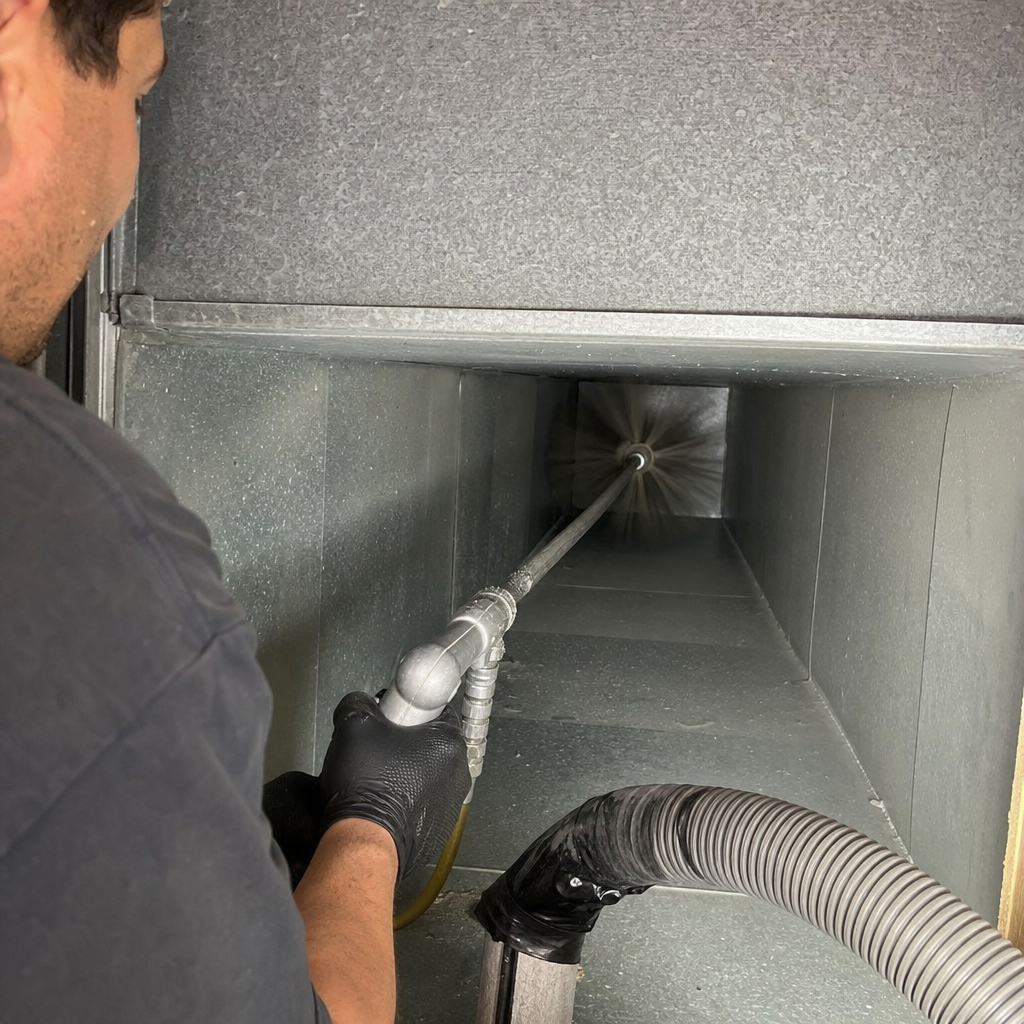
Paul Torres shows up personally as lead technician on summer jobs, and the first thing he checks isn’t the ducts—it’s the surrounding environment. A Rotobrush cleaning of a mold-prone system without addressing humidity is a temporary fix. We use Nikro equipment with HEPA containment when mold is suspected, and we document conditions with before-and-after photos for Columbus homeowners who need records for insurance or health concerns.
If you’re running A/C continuously in July and August, your filter needs monthly changes. The system is working harder, moving more air, and pulling more particulate through. A clogged filter increases pressure drop, which can pull unfiltered air through gaps in your return ductwork—often located in musty basements or hot attics.
Fall: The Highest-Value Cleaning Window in Columbus
Fall is the strategic sweet spot for Columbus duct cleaning, and most homeowners miss it. Here’s why: your system has accumulated summer’s humidity load, pollen, and dust, and you’re about to seal your home for six months of continuous heating. Cleaning in September or October means you enter the closed season with minimal debris, minimal mold spore count, and maximum system efficiency.
The efficiency angle matters in Columbus more than most markets. Our winters aren’t the coldest in the Midwest, but they’re long and variable. A furnace pushing air through debris-choked ducts works 15-20% harder to maintain temperature. With Columbus utility rates running higher than the national average for natural gas, that inefficiency converts directly to dollars.
When Paul Torres performs fall cleanings, the inspection protocol is more extensive than other seasons:
- Heat exchanger visual check — eight years of Columbus winters have taught us that cracked exchangers often show first signs as soot patterns in adjacent ductwork
- Blower compartment access — the fan blade and housing collect summer’s sticky debris, which burns off in first heating cycles producing that “first fire” smell
- Return duct integrity — negative pressure in returns pulls basement air; we check for leaks that would introduce radon or combustion gases during the sealed season
- Humidifier pad and water line — many Columbus homes have bypass humidifiers that become bacteria sources if not cleaned before heating season
Fall scheduling also avoids the spring rush. Our calendar in October typically has more flexibility than April, and you’ll have time to address any repairs—like duct sealing or humidifier service—before the first cold snap. For homeowners in Lewis Center and northern Franklin County, we offer Air Duct Cleaning in Lewis Center with the same fall priority scheduling.
The homes we see with the best long-term air quality? They’re on a fall cleaning cycle, period. Nearly 1,000 customers reviewed us, and the feedback pattern is clear: fall clients report fewer winter respiratory issues and more consistent heating comfort.
Winter: Mid-Season Monitoring Without Disruption
Once your furnace is running continuously, you don’t want to shut it down for duct cleaning. But winter isn’t a passive season—you’re gathering critical information about your system’s condition.
Monitor these specific indicators during Columbus’s heating months:
- Uneven heating room-to-room — a duct blockage or disconnected branch often reveals itself when one room stays cold while others overheat
- Dust accumulation on horizontal surfaces within 48 hours of cleaning — excessive airborne particulate suggests duct leakage or degraded filter performance
- Static electricity shocks — Columbus winter air is naturally dry, but excessive static can indicate your humidifier isn’t functioning or your ducts are over-ventilating dry outdoor air
- Carbon monoxide detector readings — while not directly a duct issue, any elevation warrants immediate HVAC and duct inspection for backdrafting or leakage
- Increased allergy or asthma symptoms — winter windows stay closed, so any reaction points to internal sources: dust mites in bedding (related to humidity) or duct-borne irritants
What you can do in winter: change filters every 6-8 weeks, run a humidifier to 35-45% relative humidity (protects respiratory membranes and reduces dust suspension), and keep supply vents unobstructed by furniture or closed doors.
What you shouldn’t do: attempt DIY duct sealing with mastic in a running system, or run portable ozone generators. We’ve been called to Columbus homes where well-meaning winter projects created more problems than they solved. The professional-grade Rotobrush and Nikro systems we use require system shutdown and containment—summer or fall procedures, not January tasks.
For dryer vent maintenance, winter is actually critical. Heavy bedding and clothing loads increase lint production, and Columbus’s cold snaps mean longer drying cycles. Our Dryer Vent Cleaning in Lewis Center and throughout Columbus includes winter safety checks for proper exhaust termination and backdraft prevention.
Building Your Multi-Year Cleaning Schedule
The “every 3-5 years” rule fails because it treats all Columbus homes identically. Your actual interval depends on five household factors that accelerate or extend the debris accumulation cycle:
| Factor | Impact on Cleaning Frequency | Recommended Interval |
|---|---|---|
| One or more pets (especially dogs, long-haired cats) | High dander and hair load; pet hair traps additional dust | Every 18-24 months |
| Recent renovation (last 3 years) | Construction dust penetrates even “sealed” systems; drywall compound is particularly adhesive | Post-renovation + every 24 months |
| Allergy or asthma sufferers in household | Lower particulate threshold for symptoms; medical benefit to reduced allergen load | Every 12-18 months |
| Home built before 1980 | Original ductwork with rough seams, possible asbestos insulation, more leakage points | Every 18-24 months + inspection for degradation |
| Home built 2000+ with tight envelope | Less infiltration but potentially higher internal pollutant concentration; verify fresh air intake | Every 30-36 months if no other factors |
Combine factors additively. A 1975 German Village home with two dogs and a child with asthma? That’s a 12-month cycle, no question. A 2015 Dublin home with no pets and no respiratory issues? 3 years is reasonable, with filter diligence.
Paul Torres has developed a simple scoring method during his 8 years doing one thing well: count your factors, set your interval, and book fall appointments two seasons ahead. The homeowners who stay on schedule rarely call with emergency issues. The ones who stretch intervals typically call in spring with mold concerns or in January with efficiency complaints.
For HVAC system cleaning specifically—coils, blower, cabinet—the interval often matches duct cleaning but serves a different purpose. Our HVAC Cleaning in Lewis Center and Columbus addresses the mechanical components that interact with your ductwork. One company for your entire duct system means coordinated maintenance, not conflicting schedules from different vendors.
Common Mistakes to Avoid
- Waiting for visible dust on vents — By the time you see it, the internal duct load is 10-20x worse. Columbus’s dark metal ductwork hides accumulation until it’s severe.
- Hiring based on coupon price alone — The $99 duct cleaning specials in Columbus typically involve a shop vacuum and 45 minutes. Professional-grade Rotobrush and Nikro systems with HEPA containment take 3-4 hours for a thorough job.
- Ignoring the dryer vent — Lint accumulation is a leading home fire cause in Franklin County. Duct cleaning without dryer vent inspection misses a critical safety intersection.
- Sealing ducts without cleaning first — Mastic over debris traps moisture and creates ideal mold conditions. Always clean before sealing.
- Running UV lights without addressing debris load — UV sterilizes surfaces it directly illuminates; it doesn’t remove the dust that shields deeper layers. It’s a supplement, not a replacement.
- Neglecting post-renovation cleaning — We’ve opened systems in Clintonville homes three years after kitchen remodels and found drywall compound still adhering to duct walls, off-gassing and trapping new debris.
- Assuming new homes are clean — Construction debris in new Columbus subdivisions is often severe; builder “rough cleans” don’t address ductwork. Schedule cleaning before occupancy when possible.
When to Call a Professional
Some conditions warrant immediate expert assessment rather than seasonal scheduling: visible mold on vent covers, persistent musty odors when the system runs, rodent or insect infestation evidence, carbon monoxide detector alerts, or sudden efficiency drops with no HVAC equipment diagnosis. These aren’t cleaning tasks—they’re diagnostic opportunities that may reveal larger system issues.
Legacy Air Duct Cleaning Columbus offers free estimates in Columbus—call (844) 945-2561. Paul Torres serves as lead technician on every project, bringing eight years of specialized air duct and indoor air quality expertise directly to your home. We’ll assess your specific seasonal risks, review your household factors, and recommend a schedule that protects your system year-round.
Frequently Asked Questions
Most Columbus homes need professional air duct cleaning every 2 to 3 years—more frequently than the national 3-5 year recommendation due to our humidity extremes and extended heating season. Homes with pets, allergy sufferers, or recent renovations should schedule every 12-24 months. Call (844) 945-2561 for a free estimate to determine your optimal interval.
Yes, fall is the highest-value cleaning window because it removes summer’s humidity and debris load before you seal your home for six months of continuous heating. A pre-heating cleaning maximizes winter efficiency and minimizes indoor air quality issues during the season you spend most time indoors.
Yes, the combination of 85-90% outdoor humidity and cold A/C airflow through metal ducts creates condensation that feeds mold growth when debris is present. The solution isn’t avoiding A/C—it’s maintaining clean ducts and controlling indoor humidity to 50% or below. Professional cleaning removes the organic load that allows mold to establish.
Proper cleaning takes 3-4 hours for an average Columbus home, uses mechanical agitation (brush systems like Rotobrush or Nikro), includes vent cover removal and washing, and provides before/after documentation. Beware of jobs completed in under 90 minutes or without equipment access to all registers—corner-cutting leaves significant debris behind.
Absolutely—it’s one of the most cost-effective investments in a new home purchase. You have no visibility into previous maintenance, pet history, smoking, or renovation debris. We recommend cleaning before move-in when possible, especially for homes in older Columbus neighborhoods with original ductwork.
Duct cleaning reduces the reservoir of dust, pollen, pet dander, and mold spores that continuously recirculates through your home. For Columbus allergy sufferers, combining seasonal duct maintenance with high-MERV filtration and humidity control typically produces noticeable symptom improvement within 2-4 weeks. Call (844) 945-2561 to discuss your specific situation—estimates are free.
The Bottom Line
Columbus’s four-season climate demands a four-season approach to duct care. Spring reveals what winter deposited. Summer creates mold risk that cleaning prevents. Fall offers the strategic deep clean before sealing. Winter provides diagnostic information for the year ahead. Generic timelines ignore these rhythms, and homeowners who follow them miss both protection and efficiency. Build your schedule around your home’s specific factors, prioritize fall for major cleanings, and treat your ductwork as the dynamic system it is—not a static component that ages on a fixed calendar.
Written by Paul Torres, Owner & Lead Technician at Legacy Air Duct Cleaning Columbus, serving Columbus since 2018.