
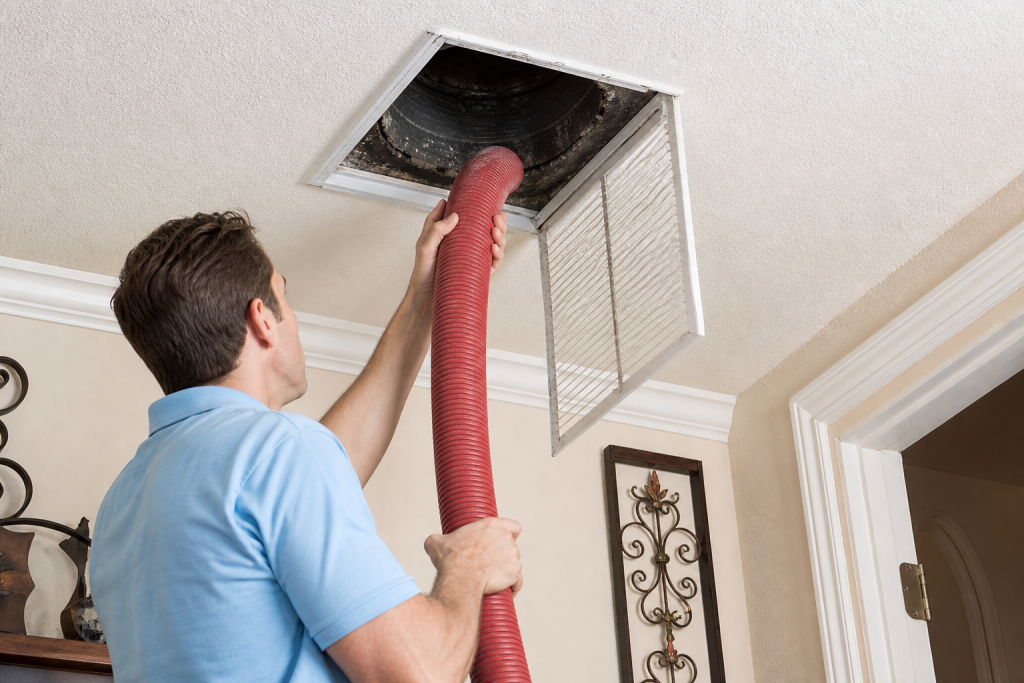
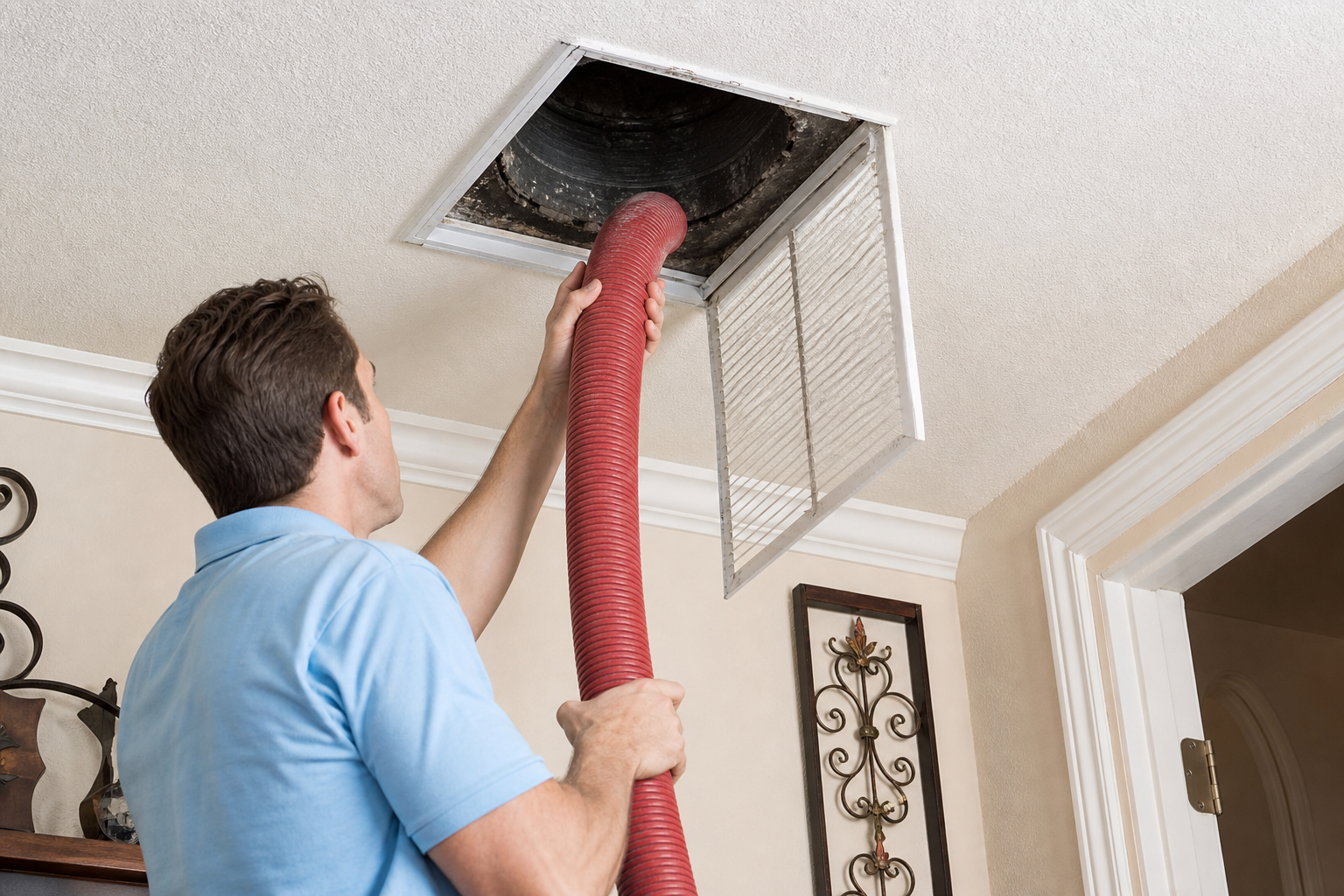
Emergency Air Duct Cleaning Near Me: What Columbus Homeowners Should Do First
If you’re searching “emergency air duct cleaning near me” in Columbus, here’s what you need to know first: most situations homeowners call urgent aren’t actually duct emergencies, and cleaning before diagnosing the root cause will cost you twice. True duct emergencies involve active water intrusion, sewage backup in the system, or post-fire smoke damage—everything else needs assessment before any Rotobrush touches your vents. If you’d rather not sort this out alone, call Legacy Air Duct Cleaning Columbus at (844) 945-2561 and we’ll walk you through it.
Here’s the mistake we see weekly in Columbus: a homeowner smells something musty when the HVAC kicks on, panics, and pays for a full duct cleaning. Two weeks later, the smell’s back. Why? Because cleaning mold out of ducts without stopping the moisture source is like mopping your kitchen floor while the sink’s still overflowing. We pulled a system apart last month in Clintonville where a family had paid another company $400 for “emergency sanitizing”—turned out a disconnected bathroom vent was dumping humid air straight into the return plenum. The ducts weren’t the problem. The connection was.
Three Situations That Are Genuine Duct Emergencies
Not every HVAC hiccup needs a midnight call. But these three scenarios in Columbus homes require fast, specific action:
- Active flooding or sewage backup in ductwork. After the 2024 summer storms hit the Franklinton and Merion Village areas, we fielded calls from homeowners whose basement returns had taken on water. If your ducts have had standing water—especially Category 2 or 3 water from sewage or ground flooding—every hour of delay grows the contamination. The insulation inside flex duct acts like a sponge and won’t dry on its own. This requires immediate HVAC shutoff, documentation for insurance, and professional assessment before any cleaning or replacement decisions.
- Post-fire smoke damage. Even a small kitchen fire in a Upper Arlington split-level can send acidic soot through the entire duct network. Smoke particles are microscopic and electrostatically attracted to metal duct walls. Standard cleaning won’t remove the odor-causing residue—this calls for source removal with mechanical agitation, then sealing or replacement of affected components. We’ve worked with Guardsman restoration products on fire jobs where the HVAC had been running during the fire, distributing contamination to every room.
- Dead animal in the system with active decomposition. It sounds dramatic, but Columbus’s squirrel and raccoon population doesn’t hibernate politely. If a rodent has accessed your ductwork through a damaged exterior cap—common in older Bexley and Grandview Heights homes with original roofline vents—the biological material needs immediate removal and the entry point must be sealed before cleaning. Otherwise you’re paying to clean ducts that’ll be re-contaminated within a season.
Three “Emergencies” That Aren’t—and What to Do Instead
These situations feel urgent but need a different first step than calling for emergency duct cleaning:
- Musty smell when the system runs. This is the big one. In Columbus’s humid summers and freeze-thaw winters, condensation in the evaporator coil cabinet or a disconnected drain line is the culprit 70% of the time we’ve investigated. First step: shut off the HVAC fan (not just the cooling), check your condensate drain pan for standing water, and look at the coil access panel for visible mold. If the smell’s strongest at one register, that register’s duct run may have a disconnected boot leaking attic or crawlspace air. Cleaning the ducts first masks the problem and gives mold a fresh food source—your removed dust.
- Visible mold on a register cover. Surface mold on the vent grille rarely means duct contamination. It’s usually bathroom humidity, cooking grease, or a cold air leak causing condensation on the metal. Wipe it with a mild cleaner, check for air leaks around the register box with a smoke pencil or even incense, and monitor for regrowth. If it returns in under two weeks, you’ve got a moisture problem, not a duct problem. We’ve saved Dublin and Westerville homeowners hundreds by diagnosing this correctly over the phone.
- Dust blowing out after construction or renovation. Frustrating, yes, but not an emergency. Your system’s been running during work, pulling particulate through returns. The correct response is a thorough filter change (MERV 11 minimum, MERV 13 if your fan can handle the static pressure) and a scheduled—same-week, not same-hour—duct cleaning with source removal. Rushing this often means paying emergency rates for work that a standard appointment handles better, since the construction dust needs time to settle into the system for effective removal.
Post-Flood Protocol: Why Moisture Readings Come First
Columbus’s clay-heavy soils and aging storm infrastructure mean basement water intrusion is a recurring reality, especially in Olde Towne East, King-Lincoln Bronzeville, and other historic neighborhoods with original foundation drainage. If your basement flooded and you have basement returns or a downflow furnace:
Do not schedule duct cleaning on day one. We use a moisture meter on every surface—duct metal, internal insulation, surrounding framing—before touching equipment. If moisture content reads above 16% in porous materials, cleaning is premature. You’ll trap moisture against metal surfaces, accelerate corrosion, and create ideal conditions for mold growth that wasn’t there before. Our process: dry the environment first (dehumidification to 50% RH or below for 48-72 hours), then assess with a borescope camera. Only then do we quote cleaning versus replacement. We’ve walked away from jobs in Grove City where the homeowner wanted immediate service but the moisture readings said wait—because doing it right matters more than doing it fast.
The First 24 Hours of a Suspected Mold-in-Ducts Situation
If you genuinely suspect mold has colonized your ductwork—not just surface spotting, but persistent health symptoms, visible growth deeper than the register, or a professional IAQ test with elevated spore counts—here’s the sequence:
- Shut off the HVAC fan completely. Don’t run it on “circulate.” Every cycle distributes spores to occupied spaces.
- Identify and stop the moisture source. Check: condensate drain, humidifier leak, disconnected duct in unconditioned space, roof leak near a chase, or oversized AC causing short-cycling and poor dehumidification. Columbus’s shoulder seasons—May and October—are prime times for humidity control failures when systems aren’t running long enough to pull moisture from the air.
- Call an HVAC technician before a duct cleaner. Controversial, maybe, but accurate. If the mold originated from a mechanical failure (coil pan leak, frozen evaporator, bad TXV causing icing), that repair is the priority. We coordinate with trusted Columbus HVAC contractors on these jobs because cleaning ducts with an active leak is throwing money into the condensate pan.
- Then call for duct assessment. When you reach Legacy Air Duct Cleaning Columbus, Paul Torres will ask about the moisture source first. If you haven’t identified it, we’ll help troubleshoot before scheduling. Our Nikro and Rotobrush systems are effective for source removal, but only after the environment supports lasting results.
Finding a Columbus Contractor on Short Notice (Without Getting Burned)
Emergency searches bring out two problematic types: the coupon-chaser with a shop vac and a bottle of vanilla spray, and the panic-pricer who quotes $800 over the phone before seeing your system. Here’s how to vet a Columbus duct contractor quickly:
- Ask what equipment they use. “Rotobrush” or “Nikro” or “Abatement Technologies” should come out of their mouth naturally. If they say “industrial vacuum” or can’t name the platform, they’re not specialists.
- Ask who shows up. With Legacy Air Duct Cleaning Columbus, Paul Torres is the lead technician on your job—not a rotating crew, not a subcontractor with a week’s training. Owner-operated accountability means the person quoting is the person doing, and the person responsible.
- Refuse phone quotes for emergency work. Any company that prices without seeing your duct configuration, contamination type, and access points is guessing—or planning to upsell on arrival. We provide free estimates in Columbus because accurate diagnosis requires eyes on the system.
- Check review volume and recency. Nearly 1,000 customers have reviewed us, and that volume across 8 years of Columbus service means consistent performance, not a few lucky jobs. Look for reviews mentioning specific neighborhoods—Short North, Italian Village, Reynoldsburg—that prove local, repeated work.
When to Call a Pro
If you’ve shut off the system, checked for obvious moisture sources, and still have persistent odors, visible contamination beyond surface level, or health symptoms that correlate with HVAC runtime, it’s time for professional assessment. In Columbus, that means a contractor who’ll inspect before quoting, who uses IAQ-grade equipment like our Rotobrush and Nikro systems, and who won’t sell you cleaning when what you need is a humidity control fix or duct repair and sealing. Legacy Air Duct Cleaning Columbus home
Related services in Columbus: If your situation involves the full HVAC system rather than just ductwork, our HVAC Cleaning in Lewis Center page covers coil, blower, and cabinet cleaning. For laundry room concerns after flooding, Dryer Vent Cleaning in Lewis Center addresses a commonly overlooked fire and moisture hazard. And for homeowners in northern Franklin County, our Air Duct Cleaning in Lewis Center service extends the same owner-led expertise to that growing area.
The Bottom Line
Most Columbus homeowners searching “emergency air duct cleaning near me” need diagnosis before action. True emergencies—active water, sewage, fire damage, or decomposing biohazards—require fast response with the right protocol. Everything else benefits from a 24-hour assessment window that identifies the root cause and prevents paying twice for the same problem. At Legacy Air Duct Cleaning Columbus, Paul Torres handles urgent calls personally: we ask the hard questions first, measure before we commit, and never upsell cleaning where repair or humidity control is the actual fix. If you’re in Columbus and need straight answers about whether your situation is truly urgent, call (844) 945-2561 for a free estimate.
Frequently Asked Questions
Emergency duct cleaning in Columbus typically runs $400–$800 for residential systems, but “emergency” pricing often inflates this by 30–50% with less reputable operators. We don’t charge emergency premiums—our standard rates apply whether you book Tuesday morning or Saturday evening because Paul Torres believes pricing should reflect the work, not your panic. The bigger risk is paying for cleaning that doesn’t address the actual problem. Call (844) 945-2561 for an exact quote—estimates are free.
Yes, mold in ductwork can trigger respiratory symptoms, allergic reactions, and in immunocompromised individuals, more serious infections—but only if the mold is actively growing and distributing spores. Many Columbus homeowners assume register discoloration means duct mold when it’s actually surface growth from room humidity. We verify with borescope inspection before recommending any remediation. If you’re experiencing symptoms that worsen when the HVAC runs, shut off the system and call for assessment.
We typically schedule urgent assessments within 24 hours across the Columbus metro, including same-day availability for genuine emergencies like post-flood contamination or fire damage. Paul Torres personally triages these calls because experience matters in urgent situations—we’ve turned down same-day cleaning requests where moisture readings showed waiting 48 hours would produce better results. Speed of response matters less than correctness of response.
For metal duct with minor water exposure and no insulation damage, cleaning and sanitizing is usually cost-effective at $300–$600. But flex duct with wet internal insulation—common in Columbus basements—almost always requires replacement because the fiberglass liner won’t dry completely and becomes a mold reservoir. We use moisture meters and borescope cameras to give you an honest replacement-versus-cleaning recommendation, not a default upsell. Call (844) 945-2561 for an assessment—estimates are free.
Written by Paul Torres, Owner & Lead Technician at Legacy Air Duct Cleaning Columbus, serving Columbus since 2018.
Need Air Duct Cleaning Help?
Call Legacy Air Duct Cleaning Columbus — licensed & insured, here with fast after-hours help in Columbus.
(844) 945-2561