
Last updated July 10, 2026
Air Duct Cleaning Permits, Codes & Inspections in OH: What You Need to Know
Here’s something most Columbus homeowners don’t realize until it’s too late: the duct cleaning job you booked for $89 can legally expose work that requires a permit, licensed modification, and inspection — and many cut-rate operators either don’t know the difference or don’t bother to tell you. In our 8 years serving Columbus neighborhoods from Clintonville to Grove City, we’ve arrived at jobs where a previous “cleaning” left access panels cut into supply trunks and patched with foil tape, or where mold discovered during a routine brush-and-vacuum service should have triggered Ohio EPA notification requirements. This guide explains exactly where Ohio law draws the line between simple cleaning and regulated work, what Columbus Building & Zoning expects, and how to protect yourself when a technician starts recommending repairs mid-visit.
Quick Answer
Standard air duct cleaning in Ohio — mechanical agitation and vacuum removal of debris from existing ductwork — does not require a building permit. However, if a technician cuts new access openings, modifies duct sizing, replaces sections of duct, or performs mold remediation, those activities trigger permit, licensing, or notification requirements under the Ohio Mechanical Code or Ohio EPA regulations. In Columbus specifically, any alteration to your HVAC distribution system beyond cleaning requires compliance with Columbus Building & Zoning codes.
Table of Contents
- Where Ohio Law Draws the Line: Cleaning vs. Modification vs. Repair
- What Columbus Building & Zoning Actually Requires
- When Mold Discovery Triggers Separate Ohio EPA Rules
- The Hidden Permit Risk: Cutting Access Panels During Cleaning
- Duct Sealing and Repair: Where Upsells Become Regulated Work
- How to Protect Yourself: Red Flags and Documentation
- Why an Owner-Operator Model Matters for Code Compliance
- Common Mistakes to Avoid
- When to Call a Professional
- Frequently Asked Questions
- The Bottom Line
Where Ohio Law Draws the Line: Cleaning vs. Modification vs. Repair
The Ohio Mechanical Code (OMC), which adopts the International Mechanical Code with state amendments, distinguishes three categories of work on HVAC systems — and only one of them is permit-free.
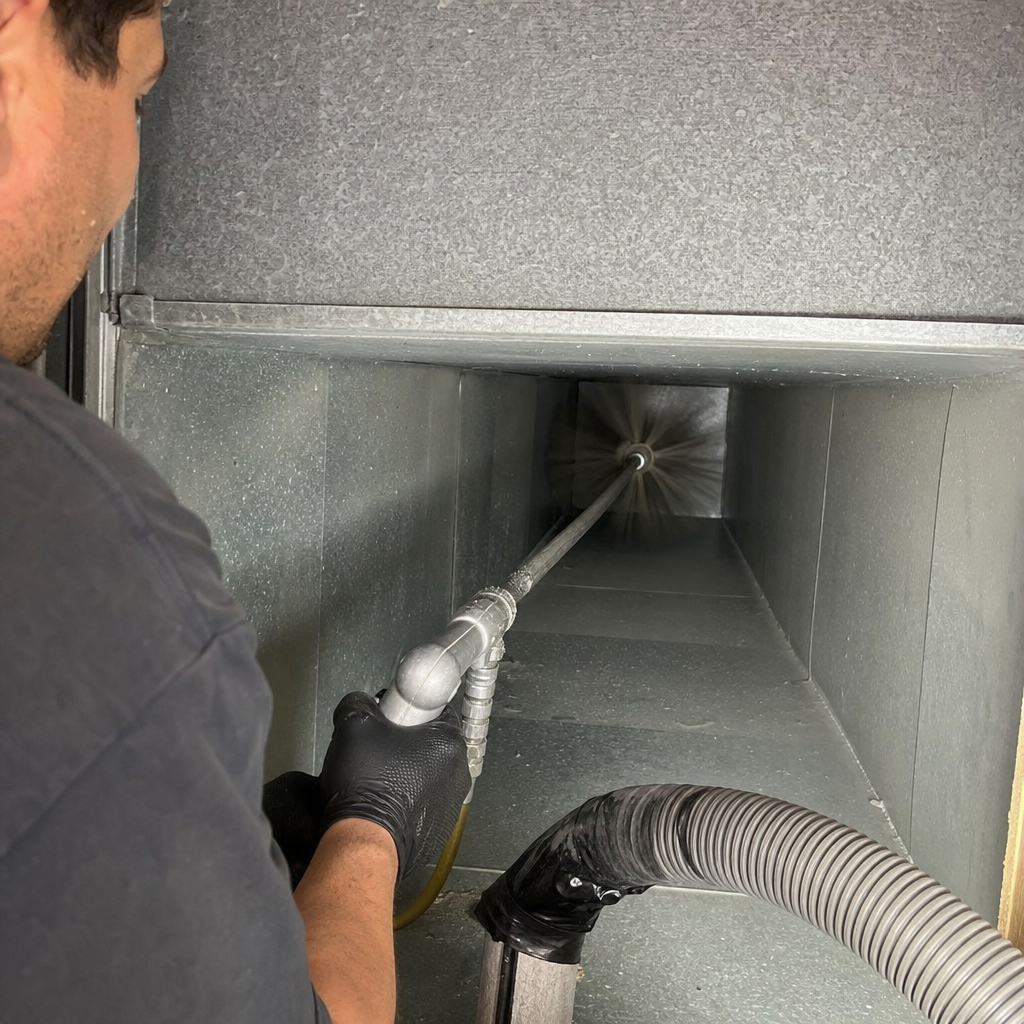
Cleaning: Mechanical removal of contaminants from existing duct surfaces using brushes, compressed air, or vacuum systems. This includes our standard Rotobrush and Nikro mechanical agitation process — rotating brushes that loosen debris while simultaneous vacuum extraction removes it. No permit required. No inspection required. This is what most Columbus homeowners actually need when they call for “air duct cleaning.”
Modification: Any change to the design, capacity, or routing of the HVAC distribution system. Cutting new access openings into duct walls (not using existing service openings), changing duct diameter, adding or removing branches, or relocating vents — all of this requires a permit under OMC Section 106 and must be performed by a licensed HVAC contractor. We’ve seen franchise crews in Columbus suburbs cut 12-inch access holes into main supply trunks to feed vacuum hoses, then patch them with foil tape rated for 200°F when duct surfaces regularly reach higher temperatures in Columbus’s summer cooling loads. That’s a modification performed without permit or proper materials.
Repair: Replacement of damaged duct sections, reconnection of separated joints, or restoration of structural integrity. Repair work occupies a gray zone: minor repairs incidental to cleaning (resealing a loose joint with mastic, for instance) typically don’t trigger permit requirements. But replacing a collapsed flex duct run or repairing fire-damaged metal ductwork does require compliance with OMC installation standards and, in Columbus, may require inspection depending on scope.
The critical distinction: cleaning preserves what’s there; modification or repair changes it. A legitimate duct cleaning company should never perform modification work without discussing permits, licensed contractor involvement, and inspection requirements with you first.
What Columbus Building & Zoning Actually Requires
Columbus operates under the Ohio Building Code and Ohio Mechanical Code with local amendments administered by the Legacy Air Duct Cleaning Columbus home Building & Zoning Services department. For residential HVAC work, here’s what actually triggers their involvement:
- No permit required: Cleaning existing ductwork, including mechanical brushing, vacuum extraction, and application of EPA-registered sanitizers (like our Guardsman treatments) to interior duct surfaces.
- Permit required: Installation of new ductwork, alteration of existing duct routing or sizing, or replacement of duct sections exceeding incidental repair scope.
- Inspection triggered: Any permitted mechanical work must pass inspection before the system returns to operation — a step we’ve seen skipped by unlicensed operators who treat duct “repair” as a same-day upsell.
Columbus’s climate creates specific pressure on this distinction. Our freeze-thaw cycles and humid summers mean duct systems experience more thermal expansion stress than in milder regions. A poorly patched access panel in a Columbus attic — where temperatures swing from 20°F to 130°F seasonally — will fail faster here than in more temperate markets. When Paul Torres inspects ductwork in older Columbus neighborhoods like German Village or Victorian Village, he’s looking for evidence of previous unpermitted modifications: mismatched duct materials, unsupported flex runs, or access patches that have already separated.
One Columbus-specific wrinkle: homes in the historic districts or those receiving Columbus Department of Development incentives may have additional preservation or energy-efficiency requirements that affect how duct modifications must be performed. Always verify whether your property falls under special overlay districts before authorizing any duct alteration work.
When Mold Discovery Triggers Separate Ohio EPA Rules
This is where many duct cleaning jobs cross into regulatory territory that operators don’t disclose — and where Columbus homeowners face real liability exposure.
During cleaning, we occasionally discover visible mold growth on duct interiors. The Ohio EPA does not regulate mold remediation specifically through a licensing program (unlike some states), but notification and work practice requirements apply under broader environmental health regulations:
- Assessment scope: If mold covers less than 10 square feet of contiguous surface inside ductwork, a qualified cleaning contractor can typically address it as part of normal service using EPA-registered antimicrobial products like those from Abatement Technologies.
- Expanded remediation trigger: If mold growth exceeds 10 square feet, involves HVAC components that distribute air throughout the home, or results from ongoing moisture intrusion (condensation, roof leaks, foundation seepage — common in Columbus’s clay-soil basements), the situation requires assessment by a mold remediation specialist following Ohio Department of Health guidance and ANSI/IICRC S520 standards.
- Documentation requirement: Any mold remediation in Ohio should include written documentation of moisture source identification, remediation scope, and post-remediation verification. We’ve reviewed competitor “mold treatments” in Columbus homes with zero documentation — just a fogging charge on the invoice.
In our experience across nearly 1,000 Columbus-area jobs, mold discovered during cleaning most commonly indicates an underlying HVAC performance problem: oversized cooling equipment causing excessive humidity, disconnected return pathways pulling damp basement air, or failed bathroom exhaust routing. Simply cleaning or treating the mold without addressing the moisture source violates basic remediation protocol and guarantees recurrence. Paul Torres flags these systemic issues during cleaning visits because our scope includes the full duct system assessment — not just the visible contamination.
The Hidden Permit Risk: Cutting Access Panels During Cleaning
This is the most common violation we encounter in Columbus homes, and it’s almost never disclosed to homeowners.
Professional duct cleaning requires access to all duct runs. Legitimate methods use:
- Existing service openings (registers, grilles, existing access panels)
- Removable components that restore to original condition
- Temporary access through plenum connections
Illegitimate or careless methods include cutting new openings into duct walls with tin snips or reciprocating saws, then “patching” them with:
- Foil tape (temperature rating insufficient for supply duct surfaces)
- Duct tape (adhesive fails within months in Columbus’s humidity cycles)
- Unbacked mastic without mechanical fastening
A proper access panel installation — when genuinely necessary for system maintenance — requires sheet metal of matching gauge, S-locks or drives for mechanical connection, sealed seams with UL-181-rated tape and mastic, and in Columbus, technically qualifies as modification work that should be performed under appropriate licensing.
We’ve repaired access panel failures in Columbus homes where the “cleaning” occurred 18 months prior and the homeowner never knew their ductwork had been cut. The telltale signs Paul Torres looks for: rectangular cut marks with bent metal edges, tape residue patterns inconsistent with factory seams, or airflow whistling from previously solid trunk lines. In one Bexley home, a franchise crew’s access cuts in the main return trunk had separated completely, pulling unfiltered attic air into the system for over a year — driving energy costs up and depositing fiberglass insulation particles throughout the home.
Duct Sealing and Repair: Where Upsells Become Regulated Work
Duct sealing represents the most frequent boundary-crossing scenario in our Columbus market. Here’s how to evaluate what you’re actually being sold:
Cleaning-adjacent sealing (typically no permit): Reapplication of mastic at accessible joints, replacement of failed tape with UL-181-rated products, or spot-sealing of register boot connections performed as part of the cleaning visit. This is maintenance-level work that preserves system integrity.
Repair-level sealing (permit territory): Aeroseal or similar injected sealant applications that alter duct pressure characteristics, replacement of disconnected duct sections, or restoration of collapsed flex duct. These change system performance and may require load calculation verification.
Modification-level work (definitely permitted): Rerouting ducts to eliminate restrictions, resizing supply runs for room additions, or converting from flex to hard duct. This requires licensed HVAC contractor involvement in Columbus.
The upsell pattern we caution Columbus homeowners about: a low-priced cleaning appointment ($79–$129) that “discovers” extensive duct damage requiring immediate $800–$2,000 “sealing” work, performed same-day by the same crew with no permit discussion, no licensed contractor involvement, and no inspection scheduling. This model — common among national franchise operations with commissioned technicians — exploits the homeowner’s lack of knowledge about where cleaning ends and regulated work begins.
Our approach at Air Duct Cleaning in Lewis Center and throughout Columbus: Paul Torres documents any duct integrity issues found during cleaning, provides written scope with photographic evidence, and if repair or modification is needed, clearly distinguishes what we can perform as cleaning specialists from what requires a licensed HVAC contractor partner. We don’t blur the lines to capture same-day revenue.
How to Protect Yourself: Red Flags and Documentation
Before any duct work begins in your Columbus home, request and verify these items:
- Written scope definition: The contract or work order should explicitly state “cleaning only” or enumerate any modification/repair work with corresponding permit status. Vague language like “complete duct service” or “full system restoration” without specificity is a warning sign.
- Access method disclosure: Ask specifically: “Will you need to cut any new openings in my ductwork?” If yes, ask how they’ll be closed and whether the method restores original structural integrity.
- Mold protocol: If mold is discovered, request documentation of extent (square footage, location photos), moisture source assessment, and treatment product EPA registration numbers. No documentation means no accountability.
- Insurance verification: Request certificate of general liability and workers compensation coverage. Don’t accept “we’re insured” — get the certificate. In Ohio, uninsured contractor injuries on your property can become your homeowner’s liability.
- Local reference verification: Ask for recent Columbus-area jobs with addresses you can drive by (with owner permission). National call centers routing to rotating subcontractor crews often can’t provide this.
One Columbus-specific protection: Ohio’s Home Solicitation Sales Act gives homeowners three business days to cancel contracts signed in their home for services over $25. If you feel pressured into same-day repair authorizations during a cleaning visit, exercise this right and seek second opinions.
Why an Owner-Operator Model Matters for Code Compliance
The structural incentive problem in this industry is straightforward: commissioned technicians paid per-job or with upsell bonuses have financial motivation to find “problems” that expand scope beyond cleaning. Franchise operations with rotating crews have no long-term accountability to Columbus homeowners or reputation stake in the community.
Paul Torres shows up personally as lead technician on your job. This matters for permit and code compliance in specific ways:
- Consistent judgment: The same person assessing whether duct damage requires licensed contractor referral on Tuesday makes that call the same way on Thursday — no variation between anonymous crew members with different training backgrounds.
- Direct accountability: When the owner performs the work, there’s no chain of delegation to obscure who made the call that an access panel could be taped rather than properly restored.
- Long-term market stake: After 8 years doing one thing well in Columbus, with nearly 1,000 customer reviews reflecting our service quality, Paul Torres has reputation incentive to identify and disclose permit-triggering work rather than absorb it into an undocumented cleaning scope.
- Equipment knowledge: Professional-grade Rotobrush and Nikro systems — the platforms we operate — are designed to access ductwork through existing openings without cutting. Technicians trained on consumer-grade shop vacuums and improvised tools are more likely to damage ductwork and create the very repair needs they then upsell.
We’ve declined repair work in Columbus homes where the scope properly required licensed HVAC contractor involvement — even when the homeowner was willing to authorize us directly. Short-term revenue isn’t worth the regulatory exposure or the compromised system performance that follows unpermitted modification.
Common Mistakes to Avoid
- Assuming “cleaning” covers everything: Columbus homeowners often authorize vague “duct service” contracts that let technicians perform undisclosed modifications. Insist on explicit scope language before work begins.
- Accepting same-day repair authorizations: A technician who discovers “critical” duct damage during a routine cleaning and demands immediate $1,500+ authorization is creating artificial urgency. Legitimate issues will still be issues after you’ve had 24 hours to verify requirements.
- Ignoring access panel quality: If your cleaning required new duct openings, inspect the closure method before paying. Foil tape on supply duct surfaces in Columbus’s thermal stress environment will fail — it’s not a matter of if, but when.
- Failing to verify mold documentation: Ohio’s lack of mold-specific licensing doesn’t mean zero standards. Any mold treatment should include EPA product registration, application scope, and moisture source identification in writing.
- Hiring based on lowest price alone: The $89 cleaning special in Columbus typically pays for itself through repair upsells, not through legitimate cleaning economics. Owner-operated specialists with professional-grade equipment and 935 verified reviews have transparent cost structures because they don’t rely on bait-and-switch revenue.
- Not checking permit status for prior work: If you’re buying a Columbus home, request permit history for HVAC modifications from Columbus Building & Zoning. Unpermitted duct alterations discovered during inspection can become negotiation leverage or repair obligations.
When to Call a Professional
Contact a qualified duct cleaning specialist when you notice visible dust accumulation at registers, reduced airflow from specific vents, or allergy symptoms that correlate with HVAC system operation. Call immediately if you suspect unpermitted duct modifications from previous work, discover visible mold during filter changes, or encounter contractors who won’t document their scope in writing.
Legacy Air Duct Cleaning Columbus offers free estimates in Columbus — call (844) 945-2561. Paul Torres personally assesses whether your situation requires straightforward cleaning, documented mold treatment within our scope, or referral to licensed HVAC partners for permitted modification work. Our HVAC Cleaning in Lewis Center and full Columbus service area includes complete duct system evaluation with photographic documentation, so you understand exactly what you’re paying for and why.
Frequently Asked Questions
No — standard mechanical cleaning of existing ductwork does not require a permit in Columbus or anywhere in Ohio. However, if the technician cuts new access openings, modifies duct sizing or routing, or replaces duct sections, those activities require compliance with the Ohio Mechanical Code and may need Columbus Building & Zoning permits. Call (844) 945-2561 for a free estimate and scope clarification before work begins.
Minor incidental repairs like resealing loose joints typically fall within a cleaning contractor’s scope. But structural repairs, duct replacement, or system modifications require licensed HVAC contractor credentials and may need permits. In Columbus, we’ve seen unlicensed cleaning crews perform extensive “repairs” that should have been permitted — leaving homeowners with no inspection record and potential insurance complications. Always ask for license classification before authorizing repair work.
Request immediate documentation: extent in square feet, location photographs, moisture source assessment, and EPA registration numbers for any treatment products. For growth under 10 square feet, qualified cleaning contractors can typically treat with registered antimicrobials. For larger contamination or HVAC-distributed growth, Ohio Department of Health guidance recommends specialist remediation following ANSI/IICRC S520. Paul Torres provides written mold findings documentation on every Columbus job where it’s discovered.
Request a permit history search from Columbus Building & Zoning Services for your address — this is public record. Visual red flags include mismatched duct materials, unsupported flex runs, rectangular cut marks with tape patches, or supply/return connections that don’t match original construction plans. During cleaning assessments in Columbus’s older neighborhoods, we routinely identify unpermitted modifications from previous owners that current residents never knew existed.
Spot-sealing with mastic during cleaning is generally maintenance, not modification. But injected sealant systems like Aeroseal that alter duct pressure characteristics, or extensive tape-and-mastic applications that change airflow patterns, may trigger regulatory scrutiny. In Columbus, we document any sealing work performed and distinguish cleaning-adjacent maintenance from performance-altering modifications that should involve load verification.
Owner-operated companies eliminate the commissioned-technician incentive structure that drives upsells into regulated work without disclosure. When Paul Torres performs your cleaning, the same person evaluating whether duct damage requires licensed contractor referral has 8 years of specialized judgment and personal reputation stake in making that call correctly. Nearly 1,000 customer reviews reflect consistent accountability that anonymous franchise crews can’t replicate.
The Bottom Line
Air duct cleaning itself lives in a permit-free zone under Ohio law — but the boundary between cleaning and regulated work is narrower than most Columbus homeowners realize, and many operators exploit that gap. The access panel cut for vacuum hose access, the “necessary” duct section replacement, the mold treatment performed without documentation — each can convert your simple cleaning into unpermitted modification or noncompliant remediation. Protect yourself with explicit written scope, verification of access methods, and contractors who distinguish clearly between what they can do and what requires licensed partners. In a market full of generalists with improvised equipment, an owner-operator with professional-grade Rotobrush and Nikro systems, 8 years of focused expertise, and nearly 1,000 verified reviews offers accountability that transcends any single job’s revenue.
Written by Paul Torres, Owner & Lead Technician at Legacy Air Duct Cleaning Columbus, serving Columbus since 2018.