
Last updated July 10, 2026
Air Duct Cleaning Maintenance Checklist for Columbus Homeowners
Here’s what most Columbus homeowners get wrong about duct maintenance: they obsess over how often to clean and ignore what happens in between. The filter you buy at Home Depot and change every 90 days might be doing more harm than good if your duct system has gaps — and most Columbus homes built before 2000 do. We’ve spent eight years in attics and crawlspaces across Franklin County, and the pattern is clear. The homeowners who breathe the cleanest air aren’t the ones who clean most frequently; they’re the ones who know which daily habits protect their system and which quietly undo a professional cleaning within months. This guide breaks down exactly what belongs on your maintenance checklist — season by season, task by task — with the Columbus-specific context that generic national guides miss entirely.
Quick Answer
A proper air duct cleaning maintenance checklist for Columbus homeowners includes monthly filter checks, quarterly register inspections, seasonal tasks tied to Central Ohio’s heating-to-cooling transitions, and annual documentation of airflow patterns and visible debris. Most homes in Columbus need professional duct cleaning every 3–5 years, but maintenance habits between cleanings determine whether that interval holds or collapses to 18 months.
Table of Contents
- Why Columbus Homes Need a Tailored Checklist
- Monthly Maintenance Tasks
- Seasonal Checklist: Spring and Fall Transitions
- What to Inspect at Supply and Return Registers
- MERV Ratings and Filter Selection for Central Ohio
- Documenting Your System Over Time
- Common Mistakes to Avoid
- When to Call a Professional
- Frequently Asked Questions
Why Columbus Homes Need a Tailored Checklist
Columbus sits at the intersection of three climate zones, and that matters more than most homeowners realize. Our summers bring sustained humidity above 70% from June through September, creating condensation inside ductwork that cooler, drier markets simply don’t face. Winters swing between polar vortex cold snaps and thaws that cycle forced-air systems on and off for months. Spring pollen counts regularly rank among the highest in the Midwest. These aren’t abstract weather facts — they’re the conditions that determine what degrades your ducts and when.
The housing stock in Columbus compounds this. In Clintonville, Bexley, and German Village, you’re often working with original ductwork from the 1920s to 1950s, typically unsealed metal with decades of patchwork. In suburbs like Dublin, Powell, and Lewis Center, the 1990s and 2000s construction boom produced thousands of homes with flex duct that’s now reaching the age where inner liners degrade and create debris sources inside the system itself. Newer construction in Hilliard and Grove City tends toward tighter envelopes — which is good for efficiency but can trap indoor pollutants if ventilation isn’t balanced.
We’ve seen this firsthand. In our eight years serving Columbus, Paul Torres has opened duct systems in Westerville homes where the homeowner’s “allergies” turned out to be fiberglass liner degradation from 1998 flex duct. We’ve found post-winter dust loads in Upper Arlington homes that explained why the family cleaned every two years instead of five — and traced it to a single disconnected return boot in the basement that was pulling in construction debris from a 1987 renovation. A generic checklist doesn’t catch these patterns. A Columbus-specific one does.
The maintenance tasks below are organized by frequency, but they’re built around what actually fails in this market: humidity-driven microbial growth, seasonal pollen infiltration, aging duct materials, and the specific pressure imbalances created by our heating-dominant climate.
Monthly Maintenance Tasks
These are the habits that cost nothing and prevent the slow degradation that turns a 5-year cleaning interval into a 2-year emergency call.
1. Filter Inspection and Replacement
Don’t just change your filter on a calendar date. Pull it and look at it. In Columbus, we see two failure modes: filters that are clogged beyond capacity because the homeowner forgot, and filters that are pristine because they’re too high-MERV for the system and air is bypassing them through gaps. A filter with dark discoloration at the edges but clean in the center is a red flag — it means air is going around, not through.
Mark the installation date on the filter frame with a Sharpie. In our experience across Columbus homes, the 90-day replacement rule collapses to 45–60 days during peak pollen season (April–May and August–September) and can stretch to 120 days in January when systems run constantly but outdoor particulate is minimal.
2. Visual Register Check
Walk your home with a flashlight. Check every supply and return register for:
- Dust accumulation on the grille fins — not surface dust you can wipe, but buildup in the crevices that suggests debris is being pushed through
- Any dark staining or discoloration on the surrounding ceiling or wall — this indicates air leakage at the boot connection, pulling attic or wall cavity air into the system
- New or worsening whistling sounds, which typically mean a restriction or pressure imbalance
In Columbus’s older neighborhoods like Victorian Village or Merion Village, pay special attention to returns on exterior walls. These were often installed without proper sealing to the framing, and decades of thermal cycling have opened gaps that bypass your filter entirely.
3. Thermostat and Humidity Monitoring
Central Ohio’s summer humidity is your ductwork’s hidden enemy. If your thermostat shows indoor humidity consistently above 55% in July and August, your system is either oversized (short-cycling without dehumidifying) or your ductwork has leaks that are introducing unconditioned attic air. Both conditions accelerate microbial growth inside ducts. Note the readings monthly. A rising trend is actionable data.
Seasonal Checklist: Spring and Fall Transitions
These are the critical windows in Columbus. The switch from heating to cooling — and back — is when accumulated debris gets disturbed and when humidity conditions change abruptly.
Spring Transition (March–April)
- Inspect the outdoor condenser pad and clear debris. Columbus’s late-winter wind patterns carry more particulate than homeowners realize. A clogged condenser reduces airflow across the coil, which drops suction pressure and can cause the indoor coil to run colder than designed — leading to condensation in ducts that don’t normally see it.
- Run the system in cooling mode for a full cycle before you need it. Listen for new noises from the blower. Spring startup is when we get calls from Worthington and Powell homeowners who discover their blower motor is laboring — often because dust loading from winter has thrown it off-balance.
- Check the condensate drain line. In Columbus’s clay-heavy soil, buried drain lines can shift and crack. A backed-up condensate line in May leads to water in the ductwork by June.
- Replace the filter before pollen season peaks. The central Ohio tree pollen window typically runs late March through early May. A fresh filter then captures the bulk of what would otherwise coat your evaporator coil and become a sticky debris magnet inside the duct system.
Fall Transition (September–October)
- Inspect the heat exchanger area if accessible. In our work across Columbus, Paul Torres has found that heat exchanger inspections during fall prep often reveal rust scale or debris that would otherwise circulate all winter. This isn’t a DIY deep clean — it’s a visual check for anything obvious that warrants a professional call.
- Seal any summer-discovered duct gaps before heating season. The thermal expansion of summer cooling contracts in fall. Gaps that were minor in July become major air leaks in December when the system runs 18 hours a day. Focus on basement connections and attic runs — the two most common failure points in Columbus’s split-level and ranch homes.
- Verify humidifier operation if equipped. Whole-house humidifiers on Columbus systems are common but frequently neglected. A failed humidifier pad that sits wet all winter becomes a mold source. Replace the pad annually, and verify the humidistat is set to 35–40% — higher settings in our cold climate cause condensation on windows and, worse, inside exterior wall cavities where ducts run.
- Document baseline airflow at each register. Use a simple tissue test: hold a tissue near each supply register with the blower on high. Note which registers have weak flow compared to others. This baseline is invaluable for detecting blockages that develop over winter.
What to Inspect at Supply and Return Registers
Registers are your window into the duct system. What you can see here determines whether you’re in maintenance mode or need professional intervention.
Homeowner-Safe Inspections
Remove the register grille — typically two screws or spring clips. With a flashlight, look into the boot (the sheet metal or flex duct connection):
- Light dust coating: Normal. Wipe it with a damp microfiber cloth.
- Clumped or fibrous debris: Indicates duct liner degradation or filter bypass. Document with a photo.
- Moisture or damp odor: Condensation issue. Check your humidity settings and register damper positions.
- Insect or rodent evidence: Droppings, nesting material, or grease marks. This requires immediate professional attention — don’t attempt cleanup yourself due to hantavirus and histoplasmosis risk from rodent or bird droppings in enclosed spaces.
Check the register fit to the wall or ceiling. Gaps larger than 1/8 inch mean conditioned air is leaking into the cavity, and unconditioned air is being drawn in at returns. In Columbus homes with plaster and lath construction — common in Grandview Heights, Clintonville, and the Near East Side — these gaps are endemic and can be sealed with proper-rated caulk, but only after confirming no asbestos-containing materials are present in older joint compounds.
What Requires a Technician
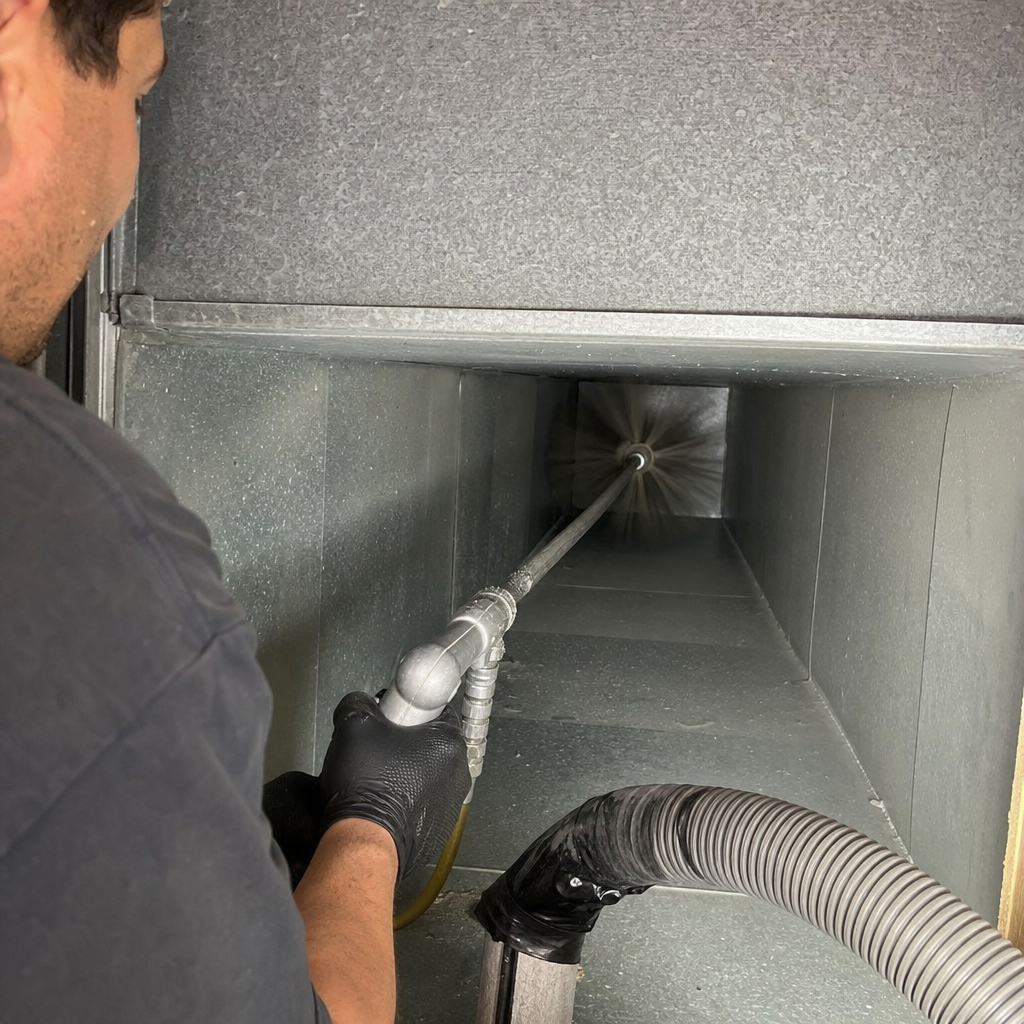
Anything beyond the boot connection is outside homeowner scope. The main trunk lines, branch ducts, and plenum chambers require mechanical agitation equipment — Rotobrush and Nikro systems like we use — to dislodge debris without damaging the ductwork. We’ve seen DIY attempts with shop vacuums and brush kits that tore flex duct liners or lodged debris deeper into the system. The rotating brushes and negative air machines used by professionals are calibrated to duct material type and diameter; consumer equipment lacks this control.
Paul Torres evaluates every Columbus job personally before equipment selection. A 1950s galvanized steel trunk in Linden requires different brush stiffness and vacuum CFM than a 2005 flex duct system in New Albany. That assessment isn’t guesswork — it’s what eight years of focused duct cleaning in this market teaches you.
MERV Ratings and Filter Selection for Central Ohio
This is where Columbus homeowners most commonly undermine their own systems. The hardware store filter aisle pushes higher MERV as “better protection,” but the physics of your specific system determine what’s actually protective versus destructive.
| System Age | Recommended MERV Range | Columbus-Specific Rationale |
|---|---|---|
| Pre-1990 (no ECM blower) | MERV 6–8 | Older permanent-split-capacitor motors lack the torque to overcome high static pressure. MERV 11+ filters in these systems cause bypass airflow around the filter frame, or worse, motor overheating. Common in Clintonville, Bexley, and German Village original systems. |
| 1990–2010 (PSC or early ECM) | MERV 8–10 | Transitional era with mixed blower types. Check your furnace manual — many 2000s-era Columbus tract homes in Hilliard and Grove City were built with MERV 8 as the design maximum. Exceeding it voids warranty coverage on blower components. |
| 2010+ (variable-speed ECM) | MERV 11–13 | Modern systems adjust airflow to maintain design CFM across filter loading. These can handle higher filtration without bypass, and the tighter envelopes of newer Columbus construction benefit from the enhanced particle capture during high-pollen periods. |
The critical detail competitors miss: MERV rating without filter fit is meaningless. A MERV 13 filter with a 1/4-inch gap at the housing edge performs like a MERV 4 because air follows the path of least resistance. In our inspections across Columbus, we find this gap problem in roughly 40% of homes — often because the homeowner bought a “better” filter that doesn’t match the original housing dimensions.
We specify Honeywell and Aprilaire filter systems when replacement is needed because their housing-to-media interfaces are engineered for zero bypass. Guardsman-treated media adds antimicrobial protection that’s relevant in Columbus’s humid summers. But the first question we ask isn’t “what MERV do you want?” — it’s “what’s your blower type and what did the manufacturer specify?”
Documenting Your System Over Time
The homeowners who get the most value from professional duct cleaning are the ones who can tell us what changed and when. Vague complaints — “the air seems dusty” — lead to broader scopes and higher costs. Specific timelines let Paul Torres target the problem.
Create a simple log. Digital or paper, consistency matters more than format:
- Date and photo of each filter change — note the brand, MERV, and visual condition
- Seasonal register inspection notes — which registers showed debris, moisture, or airflow changes
- Humidity readings — monthly highs and lows from your thermostat or a standalone monitor
- Service records — HVAC maintenance dates, findings, and any recommendations
- Occupant symptom timeline — if allergies or respiratory issues flare, note the date and any indoor environmental changes (new furniture, renovation, pet addition)
When you call for an estimate, this documentation transforms the conversation. Instead of a whole-system cleaning estimate based on square footage, we can identify whether your issue is isolated to a single return trunk, a degraded flex duct run, or a systemic filter bypass problem. In Legacy Air Duct Cleaning Columbus home visits, we’ve used homeowner logs to scope jobs at half the initial estimate because the data pointed to a specific, limited intervention.
One Dublin homeowner’s two-year log revealed that dust accumulation only appeared after a bathroom renovation — tracing it to a contractor-disconnected return duct that was pulling in attic insulation. The fix was duct repair and sealing, not full cleaning. That’s the difference documentation makes.
Common Mistakes to Avoid
- Buying the highest-MERV filter available without checking system compatibility. In Columbus’s stock of older homes, this causes blower strain, filter bypass, and ultimately more debris in the duct system than a properly fitted lower-MERV option would allow.
- Sealing registers closed in unused rooms. This is common in Columbus’s larger suburban homes with finished basements. Closing too many registers increases static pressure, strains the blower, and can cause duct leaks at weak joints — especially in flex duct systems common in 1990s construction.
- Ignoring the dryer vent as part of duct system health. A clogged dryer vent increases humidity in the utility room and adjacent ductwork, and the lint load becomes a combustion risk. We address this through our Dryer Vent Cleaning in Lewis Center and broader Columbus service area.
- Using “duct cleaning” add-ons from carpet or general cleaning services. These typically use portable vacuums without mechanical agitation — the equivalent of vacuuming your carpet without moving the furniture. The debris remains; you’ve just paid for theater.
- Waiting for visible dust at registers before acting. By the time debris is visible, the system has been circulating it for months. In Columbus’s heating-dominant climate, winter recirculation means you’re breathing degraded air before you see evidence.
- Neglecting the HVAC coil and blower cabinet. The coil upstream of your ducts is the first filter — when it’s coated, debris sloughs into the duct system continuously. Our HVAC Cleaning in Lewis Center and Columbus addresses this as part of complete system care.
- Assuming new construction means clean ducts. We’ve found construction debris — drywall dust, wood shavings, even fastener hardware — in Columbus new builds from builders who skipped rough-clean before system startup. The “new house smell” in many 2020s Columbus subdivisions is offgassing from debris baking in the ductwork.
When to Call a Professional
Maintenance has limits. These scenarios cross from homeowner care into requiring the mechanical agitation and negative air equipment that only a specialist can provide:
Visible debris at multiple registers after filter changes. Inconsistent airflow room-to-room that persists after register adjustment. Musty or chemical odors only when the HVAC runs — this indicates microbial growth or contamination in the duct system itself, not ambient indoor air. Recent rodent or insect activity in or near ductwork. Any ductwork from pre-1990 that has never been professionally cleaned. Renovation or construction activity without pre-completion duct protection.
In Columbus’s climate, we also recommend professional assessment if your home has experienced any water intrusion event — roof leak, foundation seepage, or plumbing failure — that could have affected duct runs in basements, crawlspaces, or wall cavities. Mold in ductwork doesn’t announce itself visibly until it’s established.
Legacy Air Duct Cleaning Columbus offers free estimates in Columbus — call (844) 945-2561. Paul Torres serves as lead technician on every job, bringing eight years of specialized duct and indoor air quality experience directly to your home. Our Air Duct Cleaning in Lewis Center and full Columbus service area covers everything from routine maintenance to complex remediation.
Frequently Asked Questions
Most Columbus homes need professional duct cleaning every 3–5 years, but the interval compresses to 2–3 years if you have pets, allergies, older ductwork, or live near high-construction areas like the ongoing development in the Polaris corridor or Easton. Homes with meticulous filter maintenance and no duct leakage can sometimes stretch to 7 years. Call (844) 945-2561 for an exact assessment — estimates are free.
You can clean register grilles and the visible boot area with a damp microfiber cloth, but the duct system itself requires professional equipment. Rotating mechanical brushes and high-CFM negative air machines — the Rotobrush and Nikro systems we use — are necessary to dislodge debris without damaging duct liners or pushing contamination deeper. DIY attempts with shop vacuums typically redistribute debris rather than remove it. For safety, never attempt to access ductwork in attics or crawlspaces without proper fall protection and respiratory equipment.
This almost always indicates microbial growth on the evaporator coil, in the condensate pan, or on debris deposits inside the ductwork itself. Columbus’s humid summers create ideal conditions for this. The smell intensifies at startup because the initial airflow disturbs the microbial colony. It’s not a filter problem — it’s a cleaning and possibly sanitizing issue that requires professional intervention with antimicrobial treatments.
Yes, but predictably so. Original ductwork in neighborhoods like German Village, Victorian Village, and the Near East Side often lacks sealing at joints and may include asbestos-containing materials in older insulation wraps. These aren’t disqualifying factors — they’re simply conditions that require specialist knowledge. We’ve worked with Columbus homeowners to develop maintenance plans that respect the constraints of historic systems while improving air quality measurably.
Whole-system cleaning for a typical 2,000–2,500 square foot Columbus home generally ranges from $400–$700, with variables including system accessibility, contamination level, and whether duct repair and sealing or sanitizing services are needed. Larger homes or those with multiple HVAC zones run higher. We provide exact, upfront pricing after inspection — never estimates that balloon on arrival. Call (844) 945-2561 for your specific quote.
Request before-and-after photos from inside the ductwork — any reputable technician with camera equipment can provide these. Verify that mechanical agitation was used, not just vacuum suction. Ask about the CFM rating of the collection equipment; portable units under 2,000 CFM lack the capacity for whole-system negative pressure. With nearly 1,000 customers reviewed at 4.7 stars, we’ve built our Columbus reputation on transparency in exactly these details.
The Bottom Line
Air duct maintenance in Columbus isn’t a calendar event — it’s a continuous practice shaped by our humid summers, pollen-heavy springs, heating-dominant winters, and the specific aging patterns of local housing stock. The homeowners who breathe cleanest are the ones who inspect monthly, document seasonally, and know the difference between what they can maintain and what requires Paul Torres’s hands-on expertise with professional-grade equipment. Your checklist protects the investment a proper cleaning represents; skip the maintenance, and you’re simply scheduling the next cleaning sooner.
Ready to assess your system? Call Legacy Air Duct Cleaning Columbus at (844) 945-2561 for a free estimate. Paul Torres shows up personally as lead technician on your job — eight years doing one thing well, with the Rotobrush and Nikro systems that get it done right the first time.
Written by Paul Torres, Owner & Lead Technician at Legacy Air Duct Cleaning Columbus, serving Columbus since 2018.