
Last updated July 10, 2026
How to Hire a Air Duct Cleaning Contractor in Columbus: A Step-by-Step Guide
In Ohio, there is no state license required to clean air ducts — which means the screening burden falls entirely on you, the homeowner. We’ve seen it in Columbus neighborhoods from German Village to Dublin: a magnetic-wrapped van pulls up, runs a shop vac for twenty minutes, and leaves you with $149 less and ducts that are still dirty. This guide teaches you to vet air duct cleaning contractors the way a contractor would vet subcontractors — with hard questions about equipment, proof of consistent work history, and written scope of work. You’ll learn exactly what to ask, what answers actually mean, and how to spot the red flags that separate legitimate specialists from weekend operators.
Quick Answer
To hire a qualified air duct cleaning contractor in Columbus, verify they use professional-grade mechanical agitation equipment (not just a vacuum), demand a written scope that specifies every vent and return, and confirm the technician who gives your estimate will be the same person doing the work. Ask for equipment make, model, and CFM rating — legitimate contractors in Columbus answer immediately; operators using rental equipment deflect or don’t know.
Table of Contents
- Why Ohio’s Lack of Licensing Requirements Changes Everything
- The Exact Equipment Questions to Ask Before You Book
- How to Read Reviews Like a Pro: Volume, Recency, and Context
- What a Legitimate Estimate Includes (And What’s Missing From $99 Coupons)
- Owner-Operated vs. Franchise Crew: Where Accountability Lives
- Your Written Contract and Scope Checklist
- Red Flags That Should Stop the Conversation
- Common Mistakes to Avoid
- When to Call a Professional
- Frequently Asked Questions
- The Bottom Line
Why Ohio’s Lack of Licensing Requirements Changes Everything
Most Columbus homeowners assume air duct cleaning contractors face the same regulatory scrutiny as plumbers or electricians. They don’t. Ohio requires no specific license, no continuing education, and no equipment certification to advertise duct cleaning services. The Ohio Department of Commerce regulates HVAC contractors who install or repair heating and cooling systems, but duct cleaning sits in a regulatory gray zone — anyone with a vehicle and a vacuum can claim expertise.
This matters enormously in Columbus’s housing market. Our city spans everything from 1920s brick homes in Bexley with original plaster and galvanized ductwork to new construction in Powell with flexible duct runs and complex zoned systems. A technician working on a Clintonville bungalow needs fundamentally different knowledge than one cleaning ducts in a Dublin townhouse with a variable-speed air handler. Without licensing requirements, there’s no guarantee your contractor understands either.
The practical consequence: your due diligence isn’t optional — it’s the entire quality control system. The questions you ask, the proof you demand, and the written scope you require are the only mechanisms protecting you from incomplete work, damaged ductwork, or in the worst cases, contamination introduced by poorly maintained equipment.
In our 8 years doing one thing well, we’ve been called to re-clean after cut-rate jobs where the previous contractor’s vacuum actually blew debris into living spaces because their collection unit lacked proper HEPA filtration. We’ve found flexible ducts torn by aggressive rotary brushes operated by technicians who didn’t know the difference between fiberglass and metal ductwork. These aren’t rare horror stories — they’re predictable outcomes when homeowners don’t know what to verify.
The Exact Equipment Questions to Ask Before You Book
Equipment separates legitimate air duct cleaning from surface-level vacuuming. These are the specific questions that expose who’s serious and who’s renting a Rug Doctor with attachments:
- “What make and model vacuum collection unit do you use?” Legitimate answers include names like Nikro, Abatement Technologies, or Rotobrush industrial units. If they say “a commercial-grade truck-mounted system” without specifics, press harder. Ask the model number. A contractor who owns their equipment knows it intimately.
- “What’s the CFM rating of your collection system?” CFM (cubic feet per minute) measures suction power. For residential duct cleaning in Columbus homes, you want minimum 2,000 CFM — enough to overcome the static pressure of a typical forced-air system and actually pull debris through the full duct run. Consumer-grade shop vacs run 150-200 CFM. Some “professional” units we’ve encountered in the Columbus market pull 800-1,000 CFM — better, but insufficient for deep cleaning.
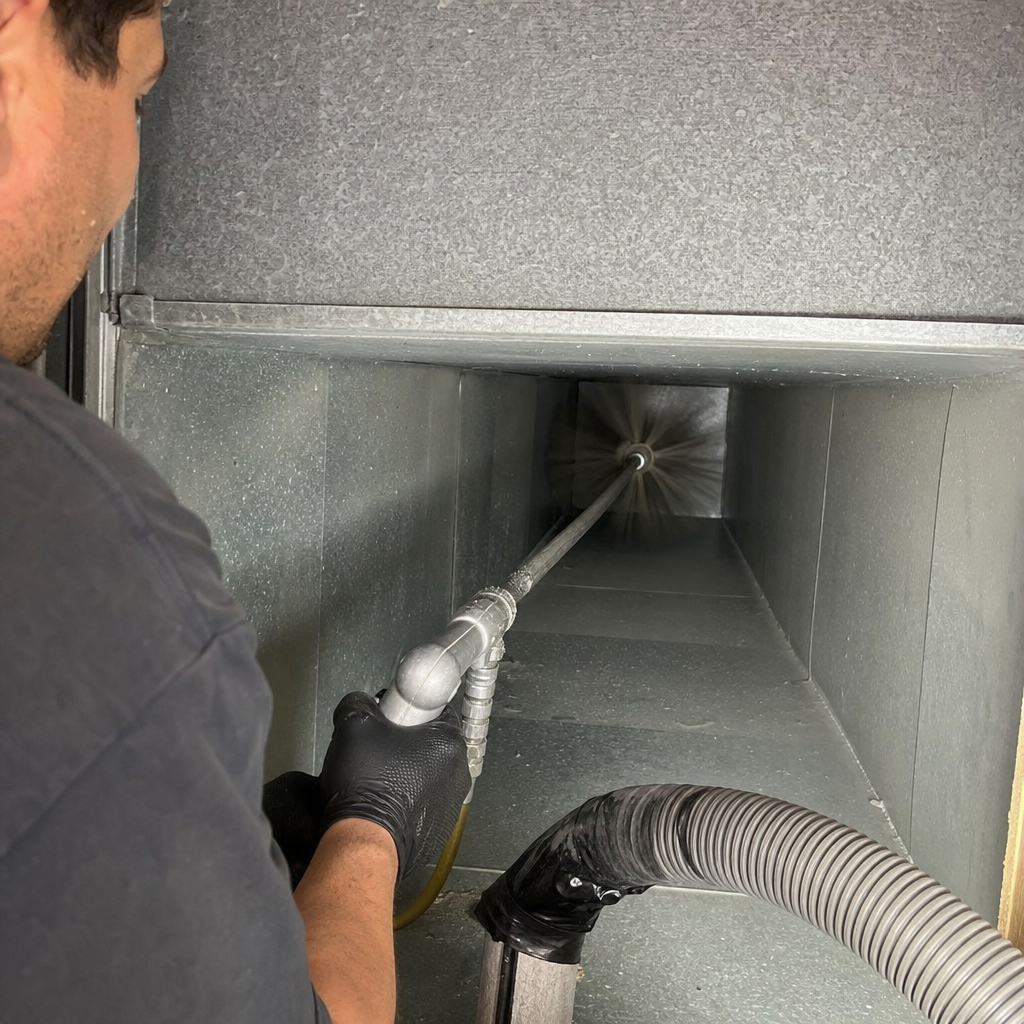
- “How do you access the collection point?” Proper duct cleaning requires cutting an access hole in the main trunk line, attaching the vacuum collection hose there, and sealing it afterward. If a contractor says they clean “through the vents” without trunk-line access, they’re not cleaning your ducts — they’re cleaning your vent covers.
- “What agitation method do you use?” Suction alone doesn’t dislodge adhered debris. Professional systems use mechanical agitation — rotating brushes, whips, or compressed-air tools that physically knock debris loose so the vacuum can capture it. We run Rotobrush mechanical brush-and-vacuum systems alongside Nikro collection units because the brush action breaks the bond between debris and duct walls that suction alone can’t touch.
- “How do you protect my home during cleaning?” The collection point, access holes, and hose runs should all be sealed and protected. Ask specifically about floor protection, corner guards, and how they handle returns in finished spaces. In Columbus’s older homes — think Victorian Village or Merion Village — narrow hallways and original hardwood require particular care.
Contractors who own professional-grade equipment will answer these questions with specificity and often enthusiasm. We’ve invested in our Rotobrush and Nikro systems because they work; we’re happy to explain why. Operators renting equipment or running consumer-grade tools will deflect, generalize, or become defensive. That response is itself diagnostic.
How to Read Reviews Like a Pro: Volume, Recency, and Context
Review literacy is essential in an unregulated industry. Here’s how to interpret what you’re seeing:
Volume over time matters more than recent spikes. A contractor with 50 five-star reviews from the last three months might be excellent — or might be a new operation that’s figured out how to solicit reviews aggressively, or worse, purchased them. A contractor with 900+ reviews accumulated over several years demonstrates sustained performance across changing seasons, economic conditions, and technician rotations. Our 935 verified customer reviews at a 4.7-star rating reflect consistent service quality across hundreds of real homes in Columbus — through humid summers when mold concerns spike, through pollen seasons when allergy sufferers notice their systems most, through the post-pandemic years when indoor air quality became a heightened priority.
Read the three-star reviews. Five-star reviews tell you what went perfectly; one-star reviews often reflect mismatched expectations or unrelated disputes. Three-star reviews reveal the actual boundaries of a contractor’s service — what they do adequately but not exceptionally, where their process shows strain. Look for patterns: “they were thorough but took longer than estimated” suggests careful work; “fast but missed several vents” suggests corner-cutting.
Check for technical specificity. Reviews mentioning specific equipment, processes, or outcomes indicate customers who were informed enough to notice details — and contractors transparent enough to explain their work. Vague reviews (“great service, very professional”) provide less signal than detailed ones (“Paul Torres showed up personally as lead technician on your job, walked me through the Rotobrush process, and showed me before/after photos of my main trunk line”).
Verify platform diversity. Reviews concentrated on a single platform may reflect incentivized feedback. Cross-reference Google, Yelp, Better Business Bureau, and industry-specific platforms. In Columbus, Angi and HomeAdvisor carry significant weight for home services — but remember these platforms sell leads to multiple contractors, so their reviews may reflect the matching service rather than direct hiring experience.
What a Legitimate Estimate Includes (And What’s Missing From $99 Coupons)
Air duct cleaning pricing in Columbus typically ranges from $300-$800 for a standard single-system residential home, with variables including home size, duct accessibility, contamination level, and additional services like sanitizing or dryer vent cleaning. Understanding this range protects you from two common traps: the bait-and-switch lowball and the inflated “whole-house package.”
A legitimate written estimate should specify:
- Exact number of supply vents and return vents to be cleaned
- Whether the main trunk lines (both supply and return) are included
- Access method — where collection point(s) will be established
- Agitation method and equipment to be used
- Whether HVAC components (blower, coils, plenum) are included or separate
- Protection measures for floors, walls, and furnishings
- Post-cleaning verification method — visual inspection, photo documentation, or particle measurement
- Total price, payment terms, and any conditions that would trigger additional charges
The $99 coupon special universally fails this standard. Here’s what we’ve found when called to assess these jobs in Columbus neighborhoods: the $99 covers a superficial vacuuming of accessible vent covers, with trunk lines, returns, and the HVAC unit all “recommended add-ons” that push final pricing well above legitimate market rates. Some operators use the low entry price to access your home for high-pressure upselling of services you don’t need. Others simply do minimal work and leave — in a market with no licensing, there’s minimal recourse.
In Worthington and Upper Arlington, where home values and homeowner sophistication run higher, we’ve noticed fewer of these operations survive — informed customers recognize the math doesn’t work. A proper duct cleaning requires 3-5 hours of skilled labor with $15,000+ in equipment; $99 doesn’t cover the truck fuel.
Owner-Operated vs. Franchise Crew: Where Accountability Lives
The structure of who actually enters your home matters profoundly for quality and accountability. Consider three common models in the Columbus market:
Owner-operated specialists: The person who answers your call, gives your estimate, and performs your service is the same individual — typically with deep technical expertise and personal reputation at stake. When Paul Torres shows up personally as lead technician on your job, accountability is immediate and non-delegable. If something’s missed, the owner knows immediately and corrects it. This model limits scale — we handle a specific volume of Columbus homes per week — but maximizes consistency.
Franchise networks: National brands with local franchisees who may or may not have direct duct cleaning experience. The technician who arrives might be a new hire following a standardized protocol, with limited authority to address unusual duct configurations or unexpected contamination. Quality varies enormously by individual franchise owner and staff turnover.
Generalist handymen: Home service companies offering duct cleaning as a seasonal add-on to carpet cleaning, pest control, or HVAC maintenance. Their equipment is often rental or consumer-grade; their training in duct system dynamics minimal. We’ve been called after these jobs in Reynoldsburg and Grove City where “duct cleaning” meant running a vacuum hose as far as it would reach and calling it complete.
The accountability question to ask: “Will the person giving my estimate be the same person doing the work?” If not, what communication system ensures your specific concerns and home’s specific characteristics transfer accurately? In our experience, the more handoffs between estimate and execution, the more details get lost.
Your Written Contract and Scope Checklist
Before anyone touches your duct system, you should have a signed document addressing:
- Complete scope enumeration. Every vent, every return, every trunk line segment. Not “all vents” — “12 supply vents, 3 return vents, supply trunk from plenum to termination, return trunk from collection point to air handler.”
- Equipment specification. Make, model, and CFM of collection unit; agitation method; filtration standard (HEPA minimum).
- Access and restoration. Where access holes will be cut, how they’ll be sealed afterward, and who bears responsibility for matching finishes if access is through finished surfaces.
- Protection and liability. Floor and surface protection; liability insurance confirmation (request certificate); workers’ compensation if applicable.
- Exclusions and add-ons. What’s explicitly not included — mold remediation, duct repair, HVAC component cleaning — and how those would be priced if needed.
- Completion verification. How you’ll confirm the work was done completely: visual inspection with you present, photo documentation, or third-party air quality measurement.
- Payment terms. Deposit requirements, progress payments, and final payment timing. Be wary of substantial upfront deposits for standard residential work.
- Recourse for incomplete work. Specific process for addressing missed areas or inadequate results, including timeline for return visits.
In Columbus’s competitive home services market, contractors who resist written scope are revealing something about their business practices. Legitimate operators welcome documentation — it protects both parties and prevents the “he said, she said” disputes that arise when expectations aren’t aligned.
Red Flags That Should Stop the Conversation
These aren’t mere cautions — they’re conversation-enders based on patterns we’ve observed across Columbus homes:
- Telemarketing or door-to-door solicitation. Legitimate duct cleaning specialists in Columbus don’t cold-call or canvass neighborhoods. These operations typically use high-pressure tactics and disappear after service.
- Refusal to specify equipment. Any contractor who won’t name their vacuum make, model, and CFM either doesn’t know or doesn’t want you to know.
- Estimate without inspection. Duct configuration varies enormously; a phone quote without seeing your system is a guess at best, bait-and-switch setup at worst.
- “Whole house” pricing without vent count. A 1,200-square-foot ranch with 8 vents and a 3,500-square-foot two-story with 22 vents cannot meaningfully share pricing. Flat-rate “whole house” offers either overcharge small homes or under-service large ones.
- Immediate pressure to book. “Today’s special pricing” or “only two slots left this month” are sales tactics, not service indicators. Quality contractors in Columbus maintain consistent scheduling without manufactured urgency.
- No local physical address. PO boxes, out-of-state headquarters, or refusal to provide a Columbus-area location suggest fly-by-night operations or franchise shells with no local accountability.
Common Mistakes to Avoid
- Equating “clean” with “sanitized.” Cleaning removes debris; sanitizing applies antimicrobial treatment. They’re separate processes with separate pricing. Don’t assume your quote includes both unless explicitly stated — and question whether sanitizing is appropriate for your situation rather than automatically upsold.
- Ignoring dryer vent cleaning. In Columbus’s climate with humid summers and freeze-thaw winters, lint accumulation accelerates duct degradation and creates genuine fire hazards. A contractor who cleans your ducts but ignores your dryer vent isn’t providing complete indoor air quality service. Dryer Vent Cleaning in Lewis Center and surrounding Columbus areas should be part of your evaluation.
- Booking based on coupon value alone. The steepest discount typically signals the most aggressive upsell or the most superficial service. Calculate total cost of complete service, not entry price.
- Neglecting HVAC component cleaning. Your blower, evaporator coil, and plenum interact directly with your ductwork. Cleaning ducts while leaving contaminated components recirculates debris immediately. HVAC Cleaning in Lewis Center demonstrates how integrated service should work.
- Failing to verify post-cleaning. Many homeowners don’t inspect results because they don’t know what to look for. Request photo documentation of trunk lines before and after, or schedule your own visual inspection with a flashlight and mirror at accessible registers.
- Assuming all “certifications” are meaningful. The air duct cleaning industry has numerous pay-for-play certifications with minimal training requirements. NADCA (National Air Duct Cleaners Association) membership carries more weight than most, but even this isn’t equivalent to state licensing — verify what the certification actually required.
- Overlooking neighborhood-specific factors. Homes in German Village with original plaster and minimal duct modifications need different approaches than new construction in New Albany with flexible duct runs. Your contractor should ask about your home’s age and construction, not apply one method universally.
When to Call a Professional
Schedule professional duct cleaning when you notice visible dust emission from registers, persistent odors when your HVAC cycles, uneven heating or cooling suggesting blockage, or after any renovation generating substantial dust. In Columbus’s pollen-intensive spring seasons, allergy sufferers often benefit from pre-season cleaning to remove accumulated debris before windows-open weather arrives.
More urgently, if you suspect mold contamination — musty odors, visible growth, or health symptoms correlating with HVAC operation — professional assessment is essential. Don’t attempt to evaluate or address potential mold yourself; disturbed spores distribute rapidly through forced-air systems.
Similarly, if your dryer vent shows any warning signs — longer drying cycles, hot exterior vent surfaces, or visible lint accumulation — this represents both efficiency loss and fire risk requiring immediate professional attention.
Legacy Air Duct Cleaning Columbus home offers free estimates throughout Columbus and surrounding communities. Paul Torres serves as lead technician on every project, bringing 8 years of specialized experience and professional-grade Rotobrush and Nikro equipment directly to your job. Call (844) 945-2561 to schedule — estimates are free, and we’ll walk through exactly what your home’s system requires before any work begins.
Frequently Asked Questions
Professional air duct cleaning in Columbus typically costs between $300 and $800 for a standard single-system residential home, depending on vent count, duct accessibility, and whether additional services like HVAC component cleaning or dryer vent service are included. Quotes below $200 for complete service should trigger immediate scrutiny — they rarely cover full trunk-line cleaning with proper equipment. Call (844) 945-2561 for an exact quote on your specific home — estimates are free.
Most Columbus homes benefit from duct cleaning every 3-5 years, though homes with pets, smokers, recent renovations, or residents with respiratory sensitivities may need more frequent service. Our climate’s humidity fluctuations — particularly the muggy July-August period and freeze-thaw cycles that stress building envelopes — can accelerate debris accumulation and microbial growth compared to drier climates. If you’re unsure about your home’s timing, a visual inspection of accessible registers and the return air pathway reveals a lot.
No — Ohio requires no certification, license, or training of any kind for air duct cleaning. NADCA membership is voluntary and indicates a contractor has chosen to meet industry-developed standards, but it’s not government oversight. This absence of regulation makes your vetting process the entire quality control system, which is why equipment verification and written scope are so essential.
Moderately, in specific circumstances. Clean ducts with unobstructed airflow allow your HVAC system to operate closer to design efficiency, but the savings are typically 5-15% at most and mainly evident in systems that were significantly obstructed. The primary benefits are indoor air quality, reduced allergen load, and extended HVAC component life — particularly blower motors working against restricted airflow. Don’t trust contractors promising dramatic utility savings; the physics don’t support it.
A thorough residential duct cleaning with proper equipment and process takes 3-5 hours for a typical Columbus home, longer for larger homes or those with complex duct layouts. Jobs completed in 90 minutes or less almost certainly skipped trunk lines, used insufficient agitation, or both. When Paul Torres shows up personally as lead technician on your job, we block adequate time — rushing duct cleaning damages ducts or leaves debris behind.
Duct cleaning addresses the distribution network — supply and return ducts, trunk lines, and registers. HVAC cleaning addresses the air handling equipment itself — blower assembly, evaporator coil, heat exchanger, and plenum. They’re complementary services: clean ducts recirculate debris if the blower and coil remain contaminated, and clean equipment distributes debris from dirty ducts. Air Duct Cleaning in Lewis Center and our HVAC cleaning service together provide complete system treatment. Call (844) 945-2561 to discuss whether your home needs one or both.
The Bottom Line
Hiring an air duct cleaning contractor in Columbus demands more diligence than most home services because the regulatory guardrails don’t exist. Your protection comes from asking specific equipment questions, demanding written scope, verifying sustained performance through substantial review history, and understanding the structural accountability differences between owner-operated specialists and rotating franchise crews. The contractor who welcomes this scrutiny — who can name their vacuum’s CFM rating, who specifies every vent in writing, who puts their own reputation on every job — is the contractor worth hiring. Nearly 1,000 customers reviewed us because we built our process around transparency and technical substance, not sales pressure and shortcuts.
Written by Paul Torres, Owner & Lead Technician at Legacy Air Duct Cleaning Columbus, serving Columbus since 2018.