
Last updated July 10, 2026
The Complete Guide to Air Duct Cleaning in Columbus
There are fewer than a handful of companies in Columbus running true negative-pressure trunk-and-branch cleaning — the rest are using shop vacs and calling it done. After eight years in this trade and nearly 1,000 customer reviews, we’ve pulled back enough vent covers to know the difference between a legitimate clean and a $49 bait-and-switch that leaves your ducts dirtier than when they started. This guide walks you through what contractor-grade equipment actually does, step by step, so you can spot the red flags before you hire anyone in Columbus.
Quick Answer
Professional air duct cleaning in Columbus costs between $400 and $900 for a typical single-family home and takes 3 to 5 hours using negative-pressure mechanical agitation systems. The process involves sealing all registers, creating access points in the main trunk line, agitating debris with rotating brushes, and extracting it under continuous suction — not simply vacuuming visible vent covers.
Table of Contents
- What Legitimate Duct Cleaning Actually Involves
- The Equipment That Makes the Difference: Rotobrush, Nikro, and Abatement Technologies
- Columbus Homes: Specific Duct Challenges We See
- The Step-by-Step Process Paul Torres Follows on Every Job
- How to Read a Real Before-and-After
- Red Flags: What Cheap Columbus Services Skip
- What Air Duct Cleaning Costs in Columbus
- How Often to Schedule in Columbus
What Legitimate Duct Cleaning Actually Involves
Most homeowners in Columbus picture a vacuum hose poked into a vent. That’s not duct cleaning — that’s vent cleaning, and it barely scratches the surface.
A legitimate clean addresses the entire HVAC distribution system: the main trunk lines that run through your basement or attic, the branch lines feeding each room, the return air pathways, and the plenum connections at your furnace. In Columbus, where we see a mix of 1950s ranch homes with long horizontal metal runs and newer construction with flex duct, the approach has to adapt to the infrastructure — but the fundamentals don’t change.
Here’s what separates a real job from a superficial one:
- Register sealing: Every supply and return vent gets sealed before the main trunk is accessed. Skip this, and your vacuum pulls air from the rooms instead of the ducts.
- Trunk line access: Technicians cut service openings in the main supply and return trunks — the large rectangular or round ducts that feed the branches. This is where the heaviest debris collects, especially in Columbus homes with basement furnaces and overhead distribution.
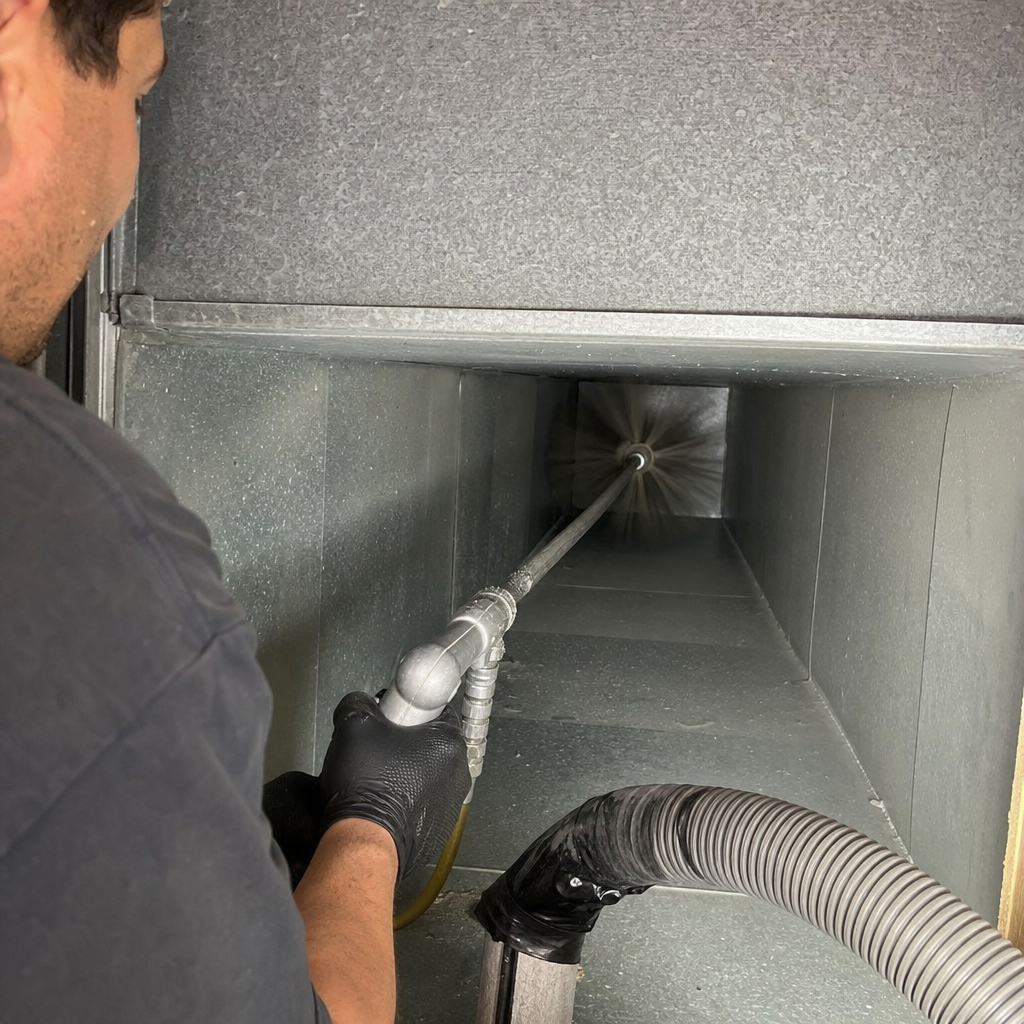
- Mechanical agitation: Rotating brushes or whips dislodge caked-on debris. Without agitation, vacuum suction alone won’t move debris that’s been baking onto duct walls for years.
- Continuous negative pressure: A high-CFM vacuum maintains suction throughout the process so dislodged debris exits the system rather than resettling.
We’ve been called to homes in Clintonville and Bexley where a previous “cleaning” took 45 minutes and left the main trunk untouched. The homeowners smelled dust every time the AC cycled — because it was still there.
The Equipment That Makes the Difference: Rotobrush, Nikro, and Abatement Technologies
Equipment names matter in this trade because they signal whether a company invested in tools designed for indoor air quality work or repurposed general-purpose shop equipment.
At Legacy Air Duct Cleaning Columbus home, we run Rotobrush and Nikro mechanical brush-and-vacuum systems — the same platforms used by industrial IAQ contractors. Here’s what each does:
Rotobrush systems use a rotating brush head on a flexible cable that travels through branch lines up to 35 feet. The brush loosens debris while a vacuum port at the tool head extracts it simultaneously. For the flexible duct common in Columbus subdivisions built after 1990, the brush stiffness is adjustable to avoid damaging the liner.
Nikro equipment provides higher-CFM negative pressure for main trunk lines and heavier debris loads. In Columbus’s older homes — think German Village or Merion Village — we encounter decades of accumulated construction debris, pet hair, and fine particulate that demands this extraction power.
Abatement Technologies portable HEPA filtration units serve as containment backup, ensuring that any particulate that escapes primary extraction gets captured rather than recirculated into your living space.
Consumer-grade alternatives — the wet/dry vacuums and compressed-air wands some competitors bring — don’t create sealed negative pressure and can’t agitate debris effectively. We’ve seen homeowners in Upper Arlington pay $89 for a “whole house special” that amounted to a shop vac hose waved at visible vent openings. The equipment list tells you what you’re actually buying.
Columbus Homes: Specific Duct Challenges We See
Columbus’s housing stock and climate create distinct duct conditions that a generic guide won’t prepare you for.
Long horizontal runs in ranch homes: The postwar ranch homes dominating neighborhoods like Worthington, Dublin, and Westerville often have 40- to 60-foot horizontal trunk lines in crawl spaces or basements. These low-velocity runs allow debris to settle, and they’re frequently inaccessible without cutting access panels — something cheap services skip entirely.
Humid summers and mold risk: Columbus averages 40 inches of annual precipitation with July humidity regularly above 70%. When attic or crawl space ductwork lacks proper insulation, condensation forms on metal surfaces. We’ve opened trunk lines in Grove City and Hilliard homes to find active mold growth on the interior surfaces — not just dust, but biological contamination requiring remediation-level cleaning and sanitizing.
Furnace-plenum connections in basements: Columbus’s freeze-thaw cycle and clay-heavy soils push many HVAC systems into basements. The plenum — the sheet metal box directly above your furnace — becomes a debris collection point, especially if filter changes have been inconsistent. It’s also where we find the most significant air leaks when ducts separate from the plenum, wasting conditioned air into unfinished basement space.
New construction debris: In fast-growing areas like Powell and Delaware County, we’ve cleaned ducts in homes less than two years old that were filled with drywall dust, wood shavings, and insulation fragments from construction. Builders rarely clean ducts before occupancy, and your first “professional” cleaning often reveals what was there from day one.
The Step-by-Step Process Paul Torres Follows on Every Job
Paul Torres shows up personally as lead technician on your job — customers get the most experienced person in the company doing the actual work, not a rotating crew of subcontractors. Here’s the sequence we’ve refined over eight years and nearly 1,000 Columbus-area homes:
- Pre-inspection and photography: We photograph interior duct surfaces through accessible registers before touching anything. This establishes baseline documentation and identifies damaged ductwork, disconnected joints, or mold that changes our approach.
- System protection: Furnace components get protected. Blower compartments are sealed if we’re not performing concurrent HVAC cleaning. Electronic components are covered against dust intrusion.
- Register sealing: Every supply and return register gets sealed with adhesive covers or magnetic blocks. This forces negative pressure to pull from the duct interior, not the rooms.
- Trunk access cutting: We cut 1-inch access holes in supply and return trunks at strategic points — typically near the plenum, at mid-run, and before end caps. These are patched with sealed access panels after cleaning.
- Agitation and extraction: Rotobrush tools navigate branch lines from register openings; Nikro high-CFM extraction runs at trunk access points. We work zone by zone, verifying suction at each stage.
- Plenum and coil contact cleaning: The plenum interior and visible evaporator coil surfaces get hand-cleaned and vacuumed. This is where competitors often stop — we treat it as a critical component.
- Post-cleaning verification: We remove register seals and run the system briefly to verify airflow balance and listen for leaks at access patches. Final photography documents the cleaned surfaces.
- Sanitizing (when requested): For homes with mold history, allergy concerns, or post-remediation needs, we apply EPA-registered sanitizers through the duct system using mechanical foggers, not pump sprayers that create uneven coverage.
A typical Columbus home takes 3.5 to 5 hours. If someone’s in and out in 90 minutes, they didn’t complete this sequence.
How to Read a Real Before-and-After
We’ve all seen the marketing photos: a filthy filter next to a clean one, or a vent cover with dramatic dust buildup. These are theater, not documentation.
Here’s what Paul Torres actually shows customers post-job — and what you should demand to see from any Columbus service:
- Interior trunk photography: Before-and-after images from inside the main duct, not just the vent opening. The difference should show clean metal surfaces, not just “less dust.”
- Debris collection documentation: Professional systems capture debris in clear collection chambers or bags. We show customers what came out of their system — typically 3 to 8 pounds of particulate in a home that hasn’t been cleaned in 5+ years.
- Register seal verification: Photos of sealed registers during the process prove negative pressure was maintained. No seals, no legitimate extraction.
- Access patch quality: Post-job photos of trunk access points show whether patches are sealed airtight. Sloppy patches leak conditioned air and draw attic or crawl space air into your system.
In our experience, homeowners in Columbus neighborhoods like Victorian Village and Short North — where historic homes often have complex duct modifications — appreciate this level of documentation because their systems have been altered multiple times by previous owners. You can’t evaluate what you can’t see.
Red Flags: What Cheap Columbus Services Skip
The $49 to $99 “whole house” specials that flood Columbus mailers and social media follow a predictable pattern. Here’s what they omit — and what you’re actually paying for when the price seems too good:
- No trunk line access: They clean visible vent covers and perhaps 3 feet of branch line. The main trunk — where 60% of debris accumulates — remains untouched.
- Positive pressure or no pressure: They blow compressed air into vents without sealing registers or maintaining negative pressure. Debris becomes airborne in your home rather than extracted.
- No agitation: A vacuum hose without a mechanical brush dislodges only loose surface dust. Caked-on debris stays put.
- Chemical upsells: The low price gets them in the door; then you’re pressured into $300 “sanitizing” treatments with unregistered products applied with garden sprayers.
- Subcontractor roulette: The company that sold you the coupon dispatches whoever’s available that day — often independent operators with no equipment investment and no accountability.
- No documentation: No photos, no debris collection, no proof the work happened. We’ve had Columbus homeowners tell us the technician spent 20 minutes per vent and left no evidence of trunk access.
Nearly 1,000 customers reviewed us — and a recurring theme in those reviews is homeowners who hired the cheap service first, realized nothing changed, then called us to do it properly. The $49 special cost them $49 plus the full price of a real cleaning.
What Air Duct Cleaning Costs in Columbus
Air duct cleaning prices in Columbus vary with home size, duct accessibility, and system condition. Here’s what we’ve observed across the local market:
| Home Size / System Type | Price Range | Typical Duration |
|---|---|---|
| Small home (under 1,500 sq ft), accessible basement trunk | $350 – $500 | 3 hours |
| Mid-size home (1,500 – 2,500 sq ft), standard layout | $450 – $700 | 3.5 – 4.5 hours |
| Large home (2,500 – 4,000 sq ft), multiple zones | $650 – $950 | 4.5 – 6 hours |
| Home with crawl space or attic trunk access only | Add $150 – $300 | Add 1 – 1.5 hours |
| Heavy debris / post-construction / mold remediation prep | Add $200 – $400 | Add 1 – 2 hours |
Add-on services that many Columbus homeowners bundle:
- Dryer vent cleaning: $120 – $180 (critical in Columbus’s humid summers when lint traps moisture)
- HVAC cleaning (blower, coil, cabinet): $200 – $350
- Duct repair and sealing: $150 – $400 depending on linear footage
- Air quality sanitizing: $150 – $250
One company for your entire duct system means you’re not coordinating multiple vendors or discovering halfway through that your cleaner doesn’t handle repairs. That’s the model we’ve built at Legacy Air Duct Cleaning Columbus — and it’s why our customers in Lewis Center and surrounding areas have specific service pages for their neighborhoods: Air Duct Cleaning in Lewis Center, Dryer Vent Cleaning in Lewis Center, and HVAC Cleaning in Lewis Center.
How Often to Schedule in Columbus
There’s no universal calendar for duct cleaning, but Columbus conditions create specific triggers:
Every 3 to 5 years for standard maintenance: This interval prevents significant accumulation without overservicing. Homes with pets, smokers, or high pollen exposure (common in Columbus’s tree-dense neighborhoods like Clintonville) trend toward the shorter end.
After any HVAC component replacement: New furnace or AC installation disturbs connected ductwork and often introduces construction debris. We clean ducts after major HVAC work as standard practice.
Visible mold or musty odors: Columbus’s July-August humidity spike creates conditions for biological growth. Don’t ignore persistent mustiness when the AC runs — it indicates moisture intrusion that needs addressing.
Post-renovation: Any drywall work, flooring replacement, or significant demolition generates fine particulate that settles in ducts. We’ve cleaned homes in Dublin and Powell where renovation dust was still circulating two years later.
Allergy symptoms that correlate with HVAC cycling: If symptoms worsen when the system runs, your ducts may be distributing accumulated allergens. This is particularly relevant in Columbus’s spring pollen season when outdoor air already challenges sensitive individuals.
Common Mistakes to Avoid
- Choosing by price alone: The $49 special is a loss-leader for upsells or a superficial job that wastes your money entirely. In Columbus, legitimate equipment and trained labor can’t be delivered at that price point.
- Ignoring the trunk lines: Ask specifically whether the service includes main trunk access and cleaning. Many homeowners don’t know to ask, and many competitors don’t volunteer that they skip this step.
- Scheduling during peak pollen season without sealing: If your home has significant duct leakage, running the system during Columbus’s peak tree pollen period (late April through May) draws unfiltered outdoor air into the return pathway. Consider duct sealing alongside cleaning.
- Expecting duct cleaning to fix HVAC problems: Cleaning improves air distribution and quality but won’t repair undersized equipment, refrigerant leaks, or failing components. We coordinate with HVAC contractors when mechanical issues surface during our inspection.
- Neglecting dryer vents: Columbus homeowners often bundle duct cleaning but skip the dryer vent — yet lint accumulation creates fire risk and reduces dryer efficiency. Our dryer vent service uses the same mechanical agitation approach as our duct work.
- Accepting verbal promises: Get the scope in writing: number of vents, trunk access confirmation, equipment type, and debris disposal method. Vague descriptions enable corner-cutting.
When to Call a Professional
Call when you notice visible dust emission from registers, persistent musty odors during HVAC operation, uneven heating or cooling across rooms, or if it’s been more than five years since your last service. In Columbus’s competitive housing market, new homeowners should prioritize duct inspection — we’ve found construction debris, pest evidence, and deteriorating flex duct in homes that passed standard inspection.
Legacy Air Duct Cleaning Columbus offers free estimates in Columbus — call (844) 945-2561. Paul Torres will walk through what your specific system needs, show you the equipment we use, and give you a fixed price before any work begins. No coupons, no bait-and-switch, just 8 years doing one thing well.
Frequently Asked Questions
A legitimate whole-house duct cleaning in Columbus typically runs $400 to $900 depending on home size, duct accessibility, and system condition. Small homes with basement access start around $350; large homes with crawl space or attic trunks can reach $950. Call (844) 945-2561 for an exact quote — estimates are free.
It can reduce circulating allergen load, particularly if ducts contain accumulated pollen, pet dander, or dust mite debris. In Columbus, where spring tree pollen and fall ragweed create significant outdoor exposure, clean ducts prevent your HVAC system from redistributing indoor accumulations. It’s one component of allergy management — not a cure — but customers report reduced symptoms when combined with quality filtration.
A thorough cleaning takes 3 to 5 hours for a typical Columbus home. Jobs under 2 hours indicate trunk lines weren’t accessed or agitation wasn’t performed. Our average across nearly 1,000 reviews is 4 hours — enough time to complete the full sequence properly.
Duct cleaning addresses the distribution network: trunk lines, branch lines, and registers. HVAC cleaning targets the mechanical components: blower assembly, evaporator coil, and condensate pan. We offer both because dirty ducts connected to a contaminated blower recirculate debris immediately. In Columbus’s humid climate, coil cleaning is particularly important for preventing mold and maintaining efficiency.
Columbus follows the Ohio Mechanical Code, which specifies duct construction standards but doesn’t mandate cleaning intervals. However, alterations to duct systems — including access panel installation — must maintain fire ratings and structural integrity. We patch access points with code-compliant materials and sealed covers, not tape or unsecured plates.
Request trunk interior photos, ask about register sealing during the process, and inspect access patch quality. In Columbus, we’ve re-cleaned homes in neighborhoods like Grandview Heights and German Village where homeowners suspected poor prior service — and found untouched main trunks with years of accumulated debris. Proper documentation doesn’t lie.
The Bottom Line
Air duct cleaning in Columbus is a legitimate service when performed with proper equipment, adequate time, and documented results. The market is flooded with cut-rate operators who’ve figured out that most homeowners can’t see inside their ducts — so they don’t actually clean them. This guide gives you the specific questions to ask, the equipment names to listen for, and the process steps that separate a real job from a performance. In a city with Columbus’s housing diversity and climate challenges, expertise matters more than a coupon.
Written by Paul Torres, Owner & Lead Technician at Legacy Air Duct Cleaning Columbus, serving Columbus since 2018.